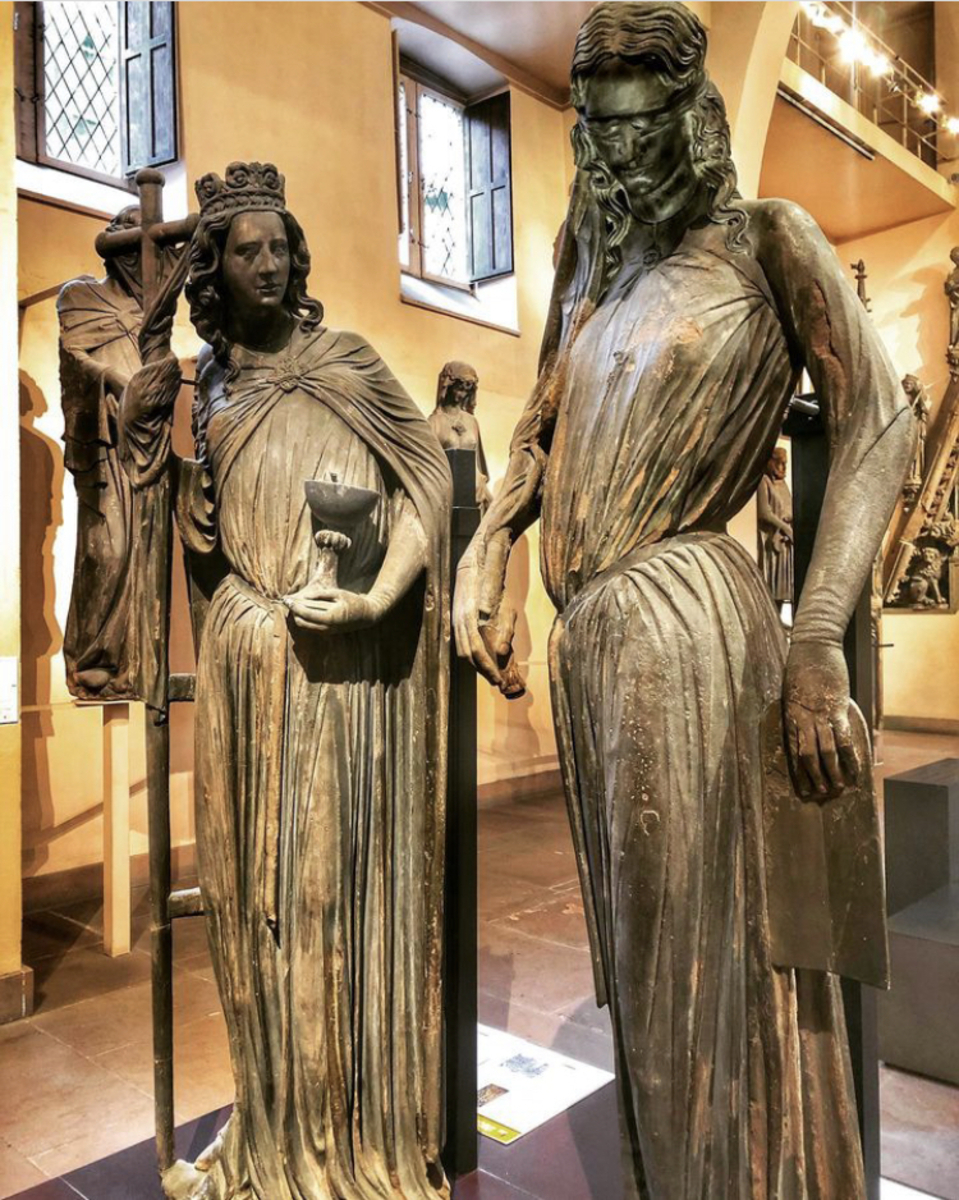

Here you are in front of the south portal of the cathedral. If you look up, you will discover two masterpieces of Gothic statuary imbued with deep symbolism: the striking representation of the opposition of two feminine allegories, Ecclesia (the Church), on the left, and Synagoga (the Synagogue), on the right. These sculptures, dating from 1225-1235, embody a recurring theme in medieval iconography: the claimed superiority of Christianity over Judaism, presented as incapable of recognizing the true Israel. Note that the original statues have been kept since 1907 at the Musée de l'Oeuvre-Notre-Dame, on the other side of the square where you are standing.
Look at Synagoga: young and beautiful like her neighbor, but her head is tilted, her eyes are blindfolded, symbolizing the spiritual blindness of the Jews. His spear is broken in several places, showing his frailty, and the Tablets of the Law that fall from his hands materialize the bygone era of the Old Testament.
In contrast, Ecclesia wears a haughty posture, wearing a crown, holding firmly the chalice, symbol of the Eucharist. The Catholic Church portrays itself as a royal figure. The two women flank King Solomon, whom the Church looks at while the Synagogue turns away from him.
The pillar of the Last Judgment located behind these doors, in the south transept, completes this sculptural ensemble marked by the notion of divine judgment.
These statues, of great artistic finesse, wear draped clothes evoking the aristocracy. Despite the professed beauty of the Synagogue, its body and face display a painful dignity. This is a far cry from the degradation of the years to come. Are we to understand that she and her people can still be saved? Can we think that these allegories necessarily work in tandem and that, without the Synagogue, the Church would lose its balance? Everyone can give free rein to their own interpretation. These allegories nevertheless remained the component of a Christian iconography charged with anti-Judaism, which contributed during the Middle Ages to put the Jews at an ever greater distance, both theologically and in society.
Photos of the 2 statues on each side of the south portal @Francoise Elkouby
