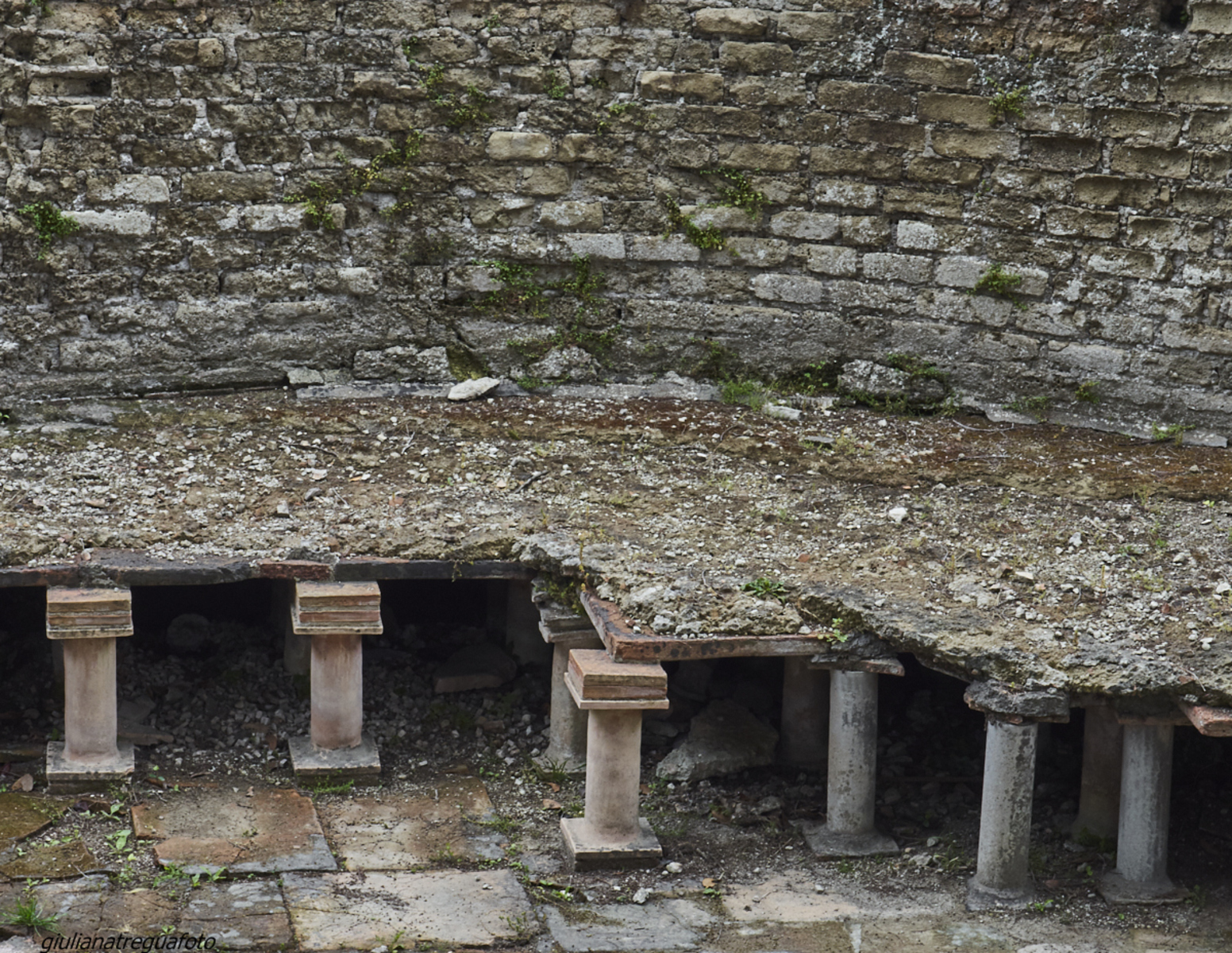

The Calidarium was the name given by the Romans to the room where you could take a hot bath. The heating system of the calidarium was very complex: it was often exposed to the south to exploit the natural heat of the sun, but it was also artificially heated by means of the insulation system. In a hollow space (the hypocaust) under the floor, supported by terracotta pillars called suspensure, hot air circulated and then went up along the walls of the room which provided for a second cavity made with tiles equipped with spacer feet (the tiles mammate) or with a series of tubules set side by side.
In the hypocaust, already known to the Greeks, there was a wood-fired furnace (the prefurnio) to heat the water, accessible from service corridors or from the outside and constantly fed and regulated by slaves. The most used fuel was wood, but charcoal or fagots were also used. The mouth of these ovens was equipped with a metal door or refractory stone plates to regulate the air entering the furnace.
This system was adopted by the Romans starting from the 1st century BC; during the republican era, however, the thermal rooms were heated only by large braziers which were not actually able to offer a constant temperature and, due to their considerable size and their number, often saturated the rooms with fumes combustion.
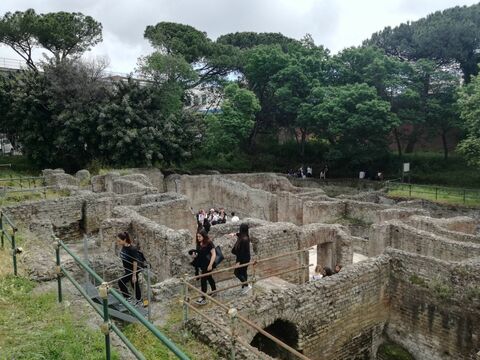
In the thermal baths of via Terracina, at today’s entrance, we can recognize the prefurnian area and the hypocaust system set up to heat the hot rooms of the complex. Immediately after the furnace area there was in fact the Calidarium, heated not only by the hypocaust under the floor, but also by the pipes that ran along the walls. The room has an apse on the north-east wall, where the small ablution tub (the labrum) was probably located, and a rectangular tub for the hot bath, the presence of a second tub, perhaps placed on the opposite side, cannot be excluded. .
Next to it there was a second heated room where it is possible to recognize a sudatorium, that is a room dedicated to sweat baths, corresponding to the sauna present in modern complexes.
Through a series of other heated rooms it was possible to reach a large circular room whose function is still uncertain; the room was also heated by the hypocaust, but not by the cavities on the walls.
Once the hot path was finished, visitors could then access the rooms for warm or cold baths.