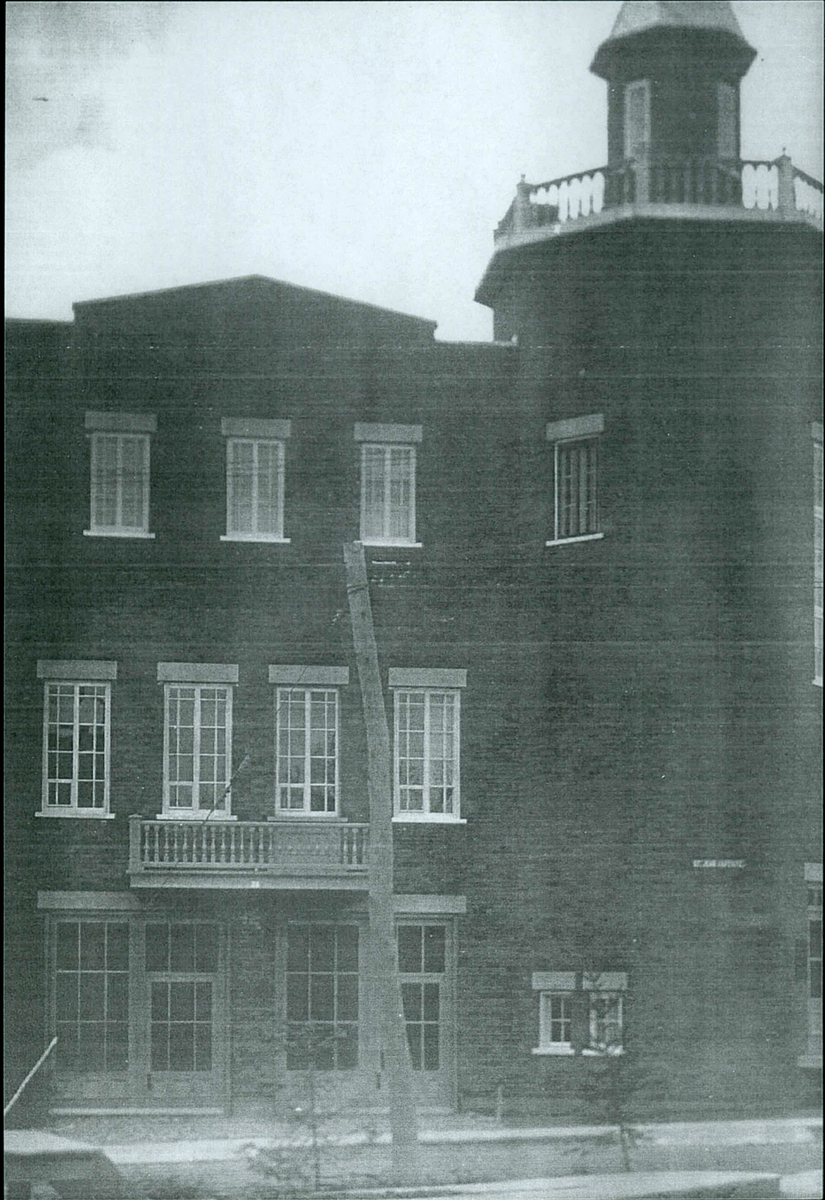

You are now standing in front of Donnacona’s town hall. Before discussing this historical building, let’s talk a bit about the town’s history.
Founded in 1915, Donnacona was originally part of Les Écureuils, a parish established in 1642 on the banks of the Saint Lawrence. Mr. Arthur Delisle was the new town’s first mayor. The establishment of a paper mill at the mouth of the Jacques-Cartier River is what led to the forming of the town. Its name came from the Donnacona Paper Company Limited, which was named after Chief Donnacona, the Iroquoian chief brought to France by Jacques Cartier in 1535. Contrary to popular belief, Chief Donnacona did not live on the banks of the Jacques-Cartier River, but of the Saint-Charles River in Quebec City, where the village of Stadaconé stood.
The arrival of Donnacona Paper led to rapid urban development and the town needed to establish various public services in order to respond to its citizens’ needs. They built a chapel in 1917, a convent in 1922, and a town hall in 1931). Leisure and sports became available; citizens had access to a movie house, the Star theatre, a baseball field and a skating rink. A golf course overlooking the Saint Lawrence River was developed in 1927 but was not accessible to the public. For many decades, the golf course was private and could only be used by the mills’ managers, a handful of doctors and certain players from the professional ice hockey franchise, the Quebec Aces.
New businesses and small industries also developed, creating a dynamic downtown. The population grew continuously, and there was strong demand for new housing. On several occasions, the municipality annexed parts of the Les Écureuils territory, until the two municipalities eventually amalgamated as Donnacona in 1967.
The construction of the building you see here is associated with some difficult years for the municipality. During the after-war period of the 1920s, the North American economy was booming and the demand for newsprint grew rapidly, allowing the town to develop. But the stock market crash of 1929 had a huge impact on the lives of Donnacona’s citizens. Municipal authorities were confronted with a harsh reality and sought to help the unemployed workers. In 1931, the municipality was authorized by the department of public works and employment to take on projects that would address unemployment in the town. During a special session of Donnacona’s town council held on February 23rd, 1931, it was decided that a new building for the town hall and fire station would be built. This new construction would replace a building that had been used not only as a town hall, but also for the piping and cement industries and to store hearses.
Construction of the new edifice was completed in 1931. The fire pump room, horse stalls and boiler room were all on the ground floor. A public hall with a stage occupied the second floor, and the third floor was turned into an apartment. An octagonal tower was built to house a staircase and was also used to dry the fire hoses. Today, this tower is no longer in use, as the fire station was moved in 1998 to an old municipal garage on the corner of Notre-Dame and Marcoux streets. Since then, the building has housed nothing but the municipal offices.
The building served as a film set for the television series “Le Clan”, which was shown on Radio-Canada in 2015. It told the story of a repentant criminal living life under a new identity and becoming a mayoral candidate for his town. The production team was specifically looking for a town hall from the 1940s. All objects that made reference to the town of Donnacona were removed for the filming and replaced by objects that represented the story’s fictional municipality.
You may now continue eastward down Rue Notre-Dame toward the tour’s final stop, which will transport us 275 years back in history.