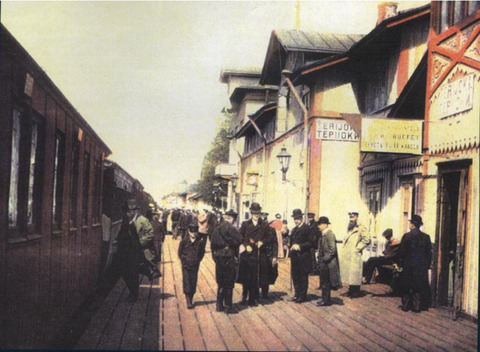

Kanneljärvi is one of the few railway stations that has preserved its Finnish name. As you could notice, other Finnish names were changed once the Karelian Isthmus was ceded to the Soviet Union.
The station shared its name with a nearby lake. It is believed that the lake received such a name because its shape resembles a traditional Finnish music instrument kantele. In 1948, both the lake and the station were renamed to Pobednoye (of Victory), but only the lake preserved this name.
Finnish javelin thrower Yrjö Nikkanen, who won a silver medal at the 1936 Summer Olympics in Berlin, was born in Kanneljärvi.
The modern railway station building appeared in 2002. It is easily recognizable thanks to its ref rood and numerous white arches.
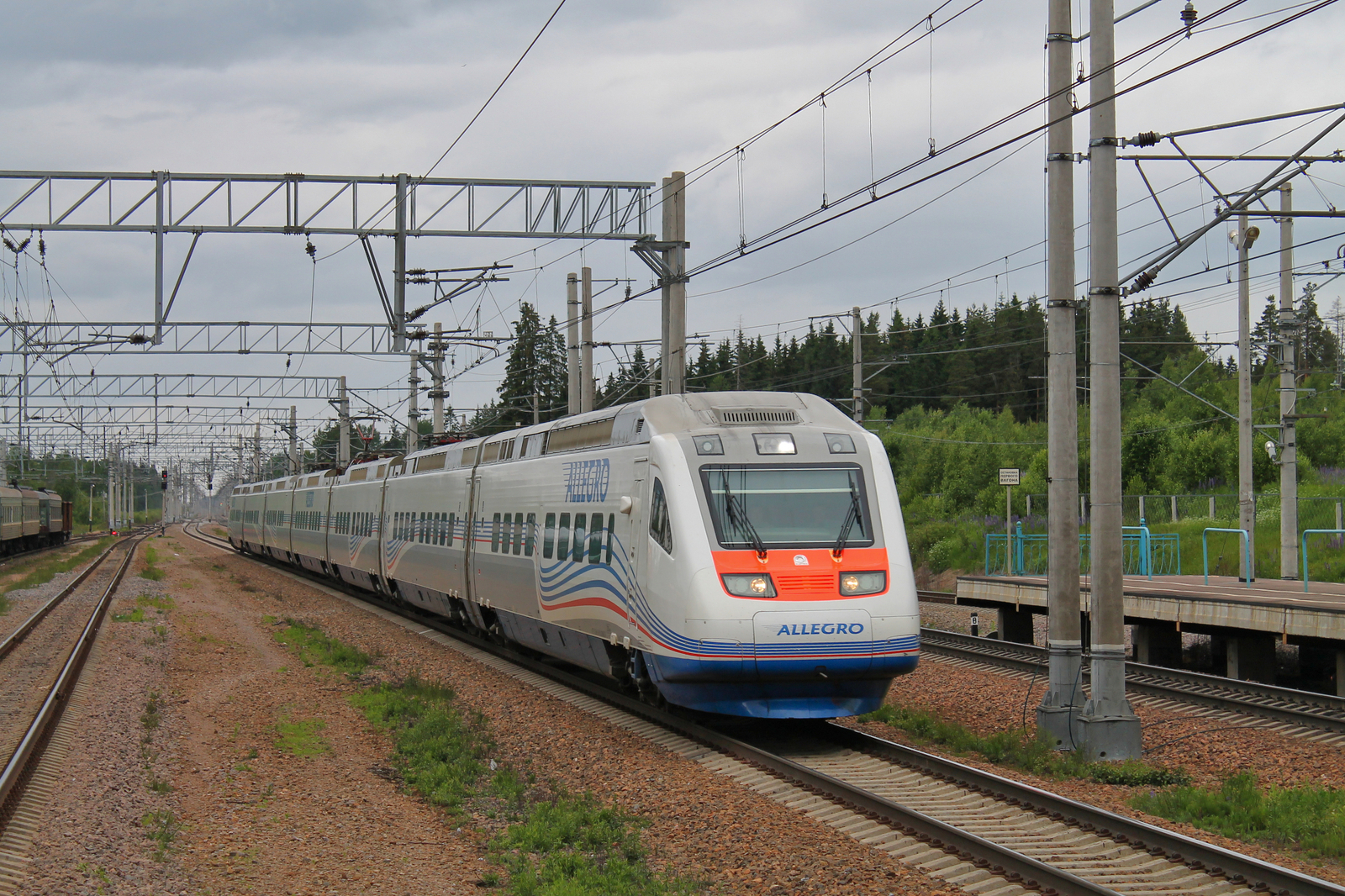
We have mentioned the past of the Finland railroad. Now, let's pass on to its present. The main milestone of the modern times is the appearance of Lastochkas, high-speed electric trains of the new generation.
Primarily, Lastochkas (Swallows) were supposed to be used during the 2014 Winter Olympics in Sochi for commuter traffic. Nevertheless, Lastochka travelled its first run a year prior to the Olympics, on January 23, 2013. Two trains departed from the Moskovsky railway station, one headed off to Bologoye, the other travelled to Veliky Novgorod. In April of the same year, Lastochka trains began running between Moscow and Nizhny Novgorod. During the summer of 2013, the new trains were servicing the Universiade in Kazan. After that, the Olympic season began, when Lastochkas were connecting the Sochi railway station with the airport, Olympic Park, and Krasnaya Polyana. After the Olympics, Lastochkas began operating all across Russia.
The first trains were manufactured by Siemens in Germany at the commission of the Russian Railways, a state-owned company. Later, Siemens also built Sapsan, an express train running between Saint Petersburg and Moscow.
Nowadays, some of the trains are manufactured in the German city of Krefeld, others under a license on the Ural Locomotives factory in Verkhnyaya Pyshma. Over a hundred Lastochka trains have already been issued.
The length of one car is 25 meters, its width comprises three and a half meters. 5 tracks make up a train, its total length is 130 meters. A double Lastochka train made up of 10 cars is used on several routs. There are 90 seats in each car. The cars are made of aluminium. The design speed of such a train is 160 kilometre per hour. The cost of one train is nearly 13 million euros.
Currently, Russia and Finland are discussing the possible launch of Lastochka trains between Saint Petersburg and the Finnish cities of Lappeenranta and Imatra.