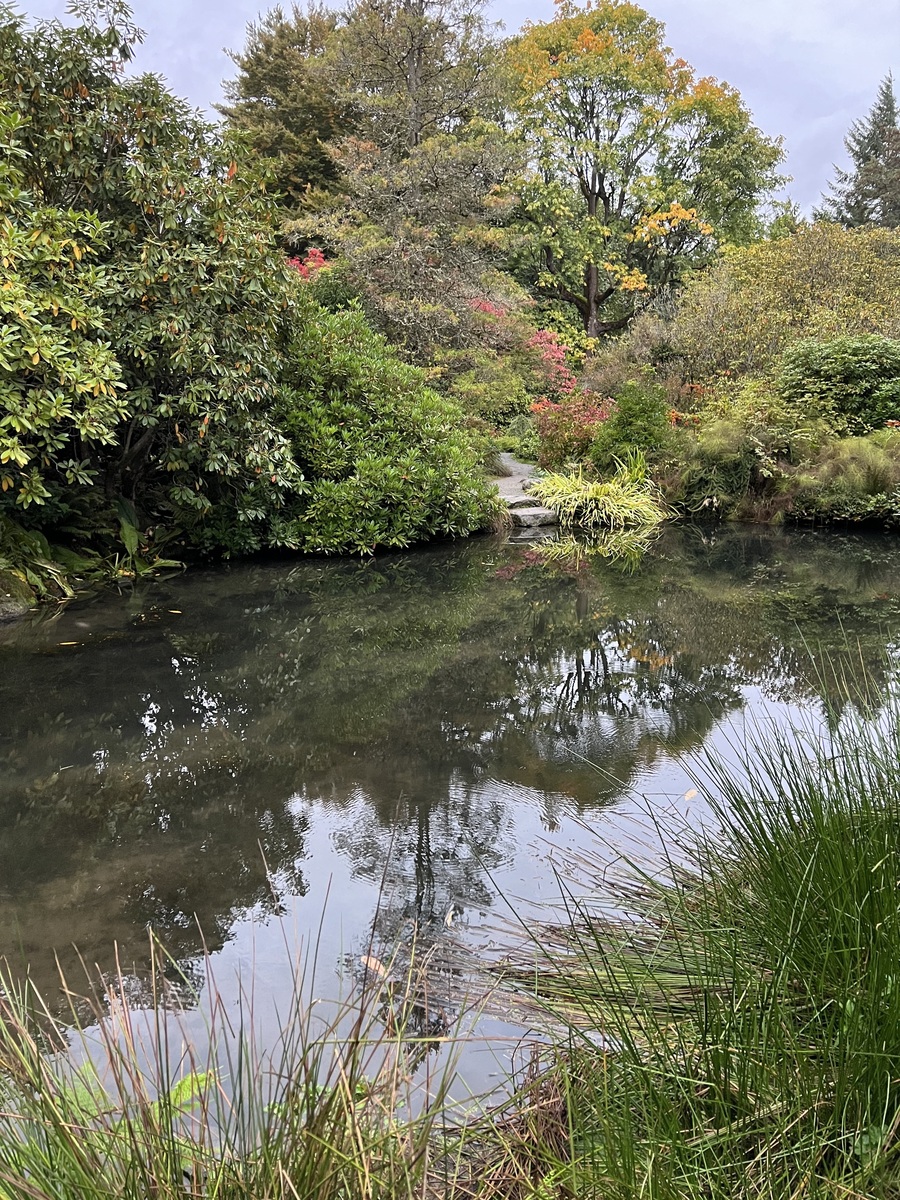
In addition to all of the beautiful trees and plants in the garden, there are also several ponds and waterfalls throughout that balance out all of the green, yellow, and red colors. Look closely at the pond at this stopping point. In the water, you will see some koi fish that live in the ponds. If it hard to find those koi fish, it is because you have just encountered an example of the impact of the stormwater runoff at the garden.
A major battle Kubota Garden is facing is how to deal with the runoff impacting the plants and creatures living there. Stormwater runoff is created when precipitation does not sink into the ground immediately. Since the roofs on houses, sidewalks and roads, and other unnatural structures do not soak up rain, the water instead collects sediments from erosion and buildings. That ultimately causes bodies of water to overflow with particles that do not belong (William), an issue that unfortunately also affects Kubota Garden. Towards the North side, there is a nearby creek called Mapes Creek that overflows with water when there is too much rain, and that water flows into the garden, especially into its ponds.
Given the history of Kubota Garden and continuous efforts to maintain its beauty and natural form, the modern issue of stormwater runoff in its ponds is an important issue that the Kubota Garden Foundation will need to address soon. According to studies done by the Washington State Department of Ecology, Washington has actually been leading the nation in stormwater treatment, specifically with permit programs and monitoring in municipalities (Keltz). On a smaller scale, some options to treat the runoff include rain barrels, which collect rain as it falls, or rain gardens, which are raised beds that absorb the rain before it flows to other land or waterways (Gittleman).
When it comes to Kubota Garden, there is a lot of research to be done to understand the impact of the runoff and which options are viable solutions. The quality of the water in the ponds can certainly worsen, so this issue needs to be addressed. As you move forward, think about what resources and support the Kubota Garden Foundation and the City of Seattle may need to solve this kind of problem.
Gittleman, M. (2011, July 6). Estimating stormwater runoff for Community Gardens in New York City. CUNY Academic Works. Retrieved October 29, 2021, from https://academicworks.cuny.edu/hc_sas_etds/2/ (Links to an external site.).
Keltz, C. (2020, December 17). Washington is leading the nation in stormwater management. Washington State Department of Ecology. Retrieved October 23, 2021, from https://ecology.wa.gov/Blog/Posts/December-2020/Celebrating-our-Municipal-Stormwater-Permit-Progra (Links to an external site.).
William, R., Gardoni, P., & Stillwell, A. S. (2018, November 20). Reliability-based approach to investigating long-term clogging in Green Stormwater Infrastructure. Journal of Sustainable Water in the Built Environment. Retrieved October 29, 2021, from https://ascelibrary.org/doi/full/10.1061/JSWBAY.0000875 (Links to an external site.).