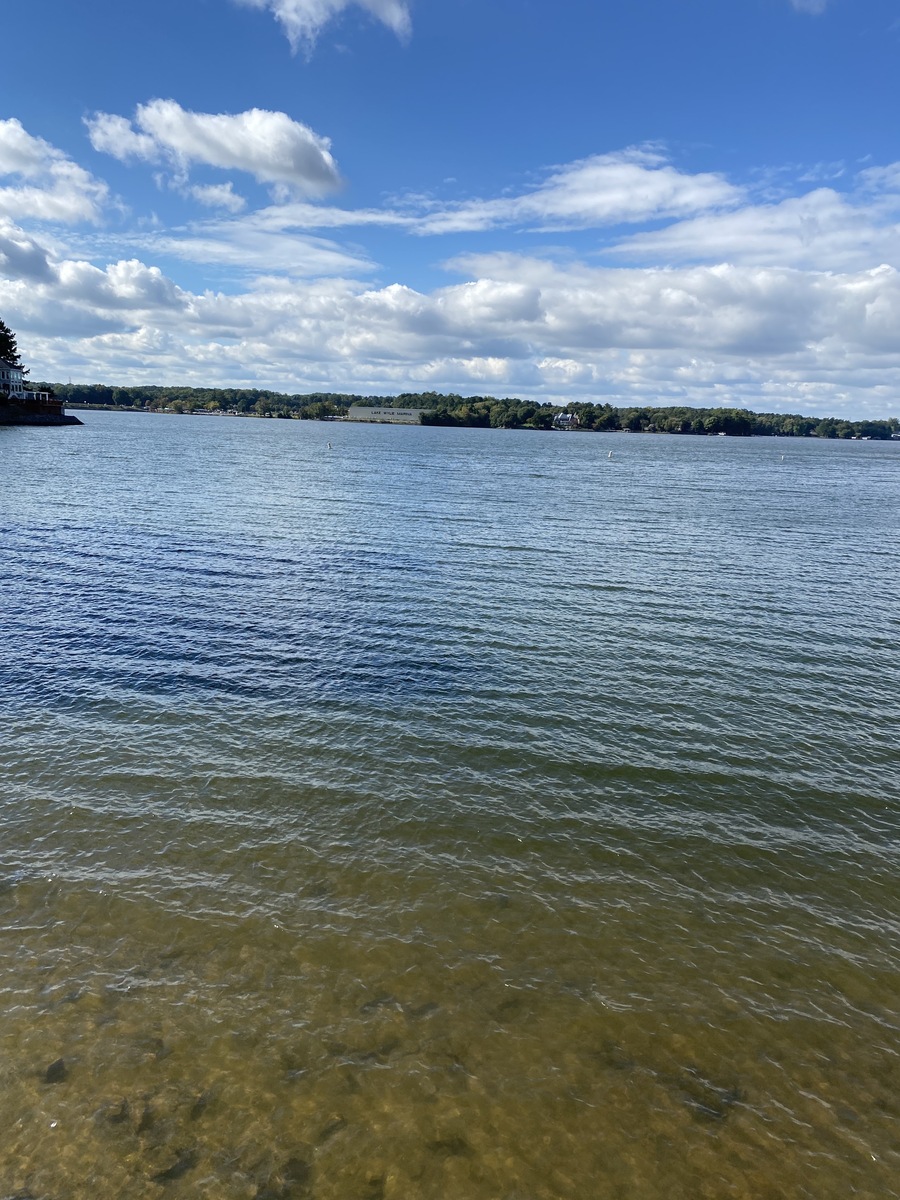

Welcome to our last stop, the lake neighborhood! Here, we are overlooking the beautiful, blue waters of Lake Wylie, which is located on the border of North and South Carolina. If you take a look around, you’ll see clear blue skies and hear the gentle lapping of waves on the shore. If you look up at the sky, you might even be able to catch a glimpse of a resident I want to introduce you to.
Everyone, say hello to the osprey! (osprey chirps) This large bird of prey lives near the water and is identified by his brown and white feathers and black beak. He primarily makes his nest on top of dead trees or powerline poles, and both parents will fiercely defend this nest while the babies are still at home (US Fish and Wildlife Service). Ospreys have had trouble building their nests at Lake Wylie because of residential development along the shores. The water of the lake has also been contaminated in the past, which caused the eggshells of these birds to weaken, leading to a lower reproduction rate. The osprey’s primary source of food is fish, which he catches by diving into the water and snatching it with his sharp talons. By keeping the fish from overpopulating the lake, he plays a significant role in keeping his neighborhood balanced and healthy (North Carolina Wildlife Federation).
One fish that is important to this neighborhood is the grass carp. His scales are typically brownish-yellowish and his underside is white. He was originally from Asia but immigrated here to help with the control of weeds on this body of water (Nico, 2020). In this particular neighborhood, there is an overpopulation of a plant called hydrilla. This plant is invasive and, if left unattended, can grow over the entire surface of the water and affect recreational activities, such as fishing and boating. It can also lower the level of oxygen in the entire lake, which can cause some of the native residents to die (Lake Wylie Marine Commission).
Did you know there are actually multiple ways that you can get involved in helping to protect this neighborhood? One way is to volunteer to help members of the Lake Norman Wildlife Conservationists build osprey nesting platforms along the shores of the lake. (North Carolina Wildlife Federation). You can also assist them in the building of fish attractors, a structure that helps to protect fish and other animals from predators that live in the water. Both of these initiatives work to ensure that the neighborhood residents who live at Lake Wylie have a happy and prosperous future!
How is everybody feeling? We covered a lot of ground on our tour!
Today you were introduced to the different neighborhoods that make up the wonderful community of McDowell Nature Preserve and Center. You have also met some of the important neighborhood residents: the pileated woodpecker, the barred owl, the Schweinitz’s sunflower, the Georgia aster, the osprey, and the grass carp fish. We learned that the preservation of each of these neighbors is crucial because they play an important role in making sure their community functions to the best of its ability.
Now that we have visited this community and met its members, I hope that you have a different perspective on the nature in your area. Maybe now you will see it as a thriving community filled with distinct and diverse neighborhoods. Rather than viewing forests, prairies, or lake areas as “undeveloped” land, you’ll understand that they were never really undeveloped to begin with. When we build homes or businesses, we always impact the neighborhoods that are already there.
I also hope that you think about the ways that you can contribute to the longevity of these communities, such as volunteering to build osprey nests, donating to restoration sites, or seriously considering where you choose to live or build your next home. We can all play a role in preserving and protecting these beautiful neighborhoods for generations to come.
Osprey photo by Steve Bower via Shutterstock (licensed)
Grass carp fish photo by Rostislav Stefanek via Shutterstock (licensed)
All other photos by Emily Benjamin
All background sounds in this talk are licensed by Videvo.