
Meanwhile, our train has crossed the border between two districts of Saint Petersburg, and, with Primorskiy district behind us, we arrived at Sestroretsky district. Even if it might look like we have left Saint Petersburg, our train is still passing the administrative territory of the second largest city of Russia. In fact, before Moscow was expanded in 2012, the area of Saint Petersburg was nearly 1.5 times bigger than that of the Russian capital.
As we remember, Primorskoye highway is accompanying our train almost all the way along the coast of the Gulf of Finland. If you were to drive on this highway, it would take 45 more kilometres to finally leave the administrative border of Saint Petersburg!
Our next stop is called Lisy Nos, or “Fox’s nose” in Russian. To understand why it was awarded such a name, you would need to see the bird’s eye view of the coast of the Gulf of Finland. There is a cape standing out against the smooth surface of the coastline that does look like the nose of this cunning animal.
The Novgorod Chronicle of 1500 mentions a settlement with a similar name. As we already know, Peter the Great liked this place, and he ordered to plant an oak grove in Lisy Nos which he named Sredniye Dubki, or “Middle Oaks”. As you might remember, “Closer Oaks” were to be found in Lakhta, while Dalniye Dubki, or “Further Oaks”, wait for us in Sestroretsk.
When the Primorskaya railroad was opened, Lisy Nos experienced a boom of dacha developments. The village still looks pretty much like it did back then. These lands also belonged to the rich noble family of Stenbock-Fermors. As we mentioned before, they divided their lands into parcels.
The parcel where Lisy Nos appeared was called Vladimirovka after one of the family members, Count Vladimir Stenbock-Fermor. Aleksandrovka village, which we will see later during our journey, is named after his son Alexander, while Olgino, which we have already passed, is named after his daughter-in-law, Alexander’s wife Olga.
This family is considered to be Russian, its members had Russian names. However, they were descendants of the ancient Swedish family of Stenbocks that originated in the 12th century, as well as of the Scottish family of Fermors whose history began in the 15th century.
During the Soviet era, Lisy Nos was considered to be a workers’ village, even though it preserved its recreational status and particular atmosphere. Nowadays, it’s very popular among dacha-lovers.
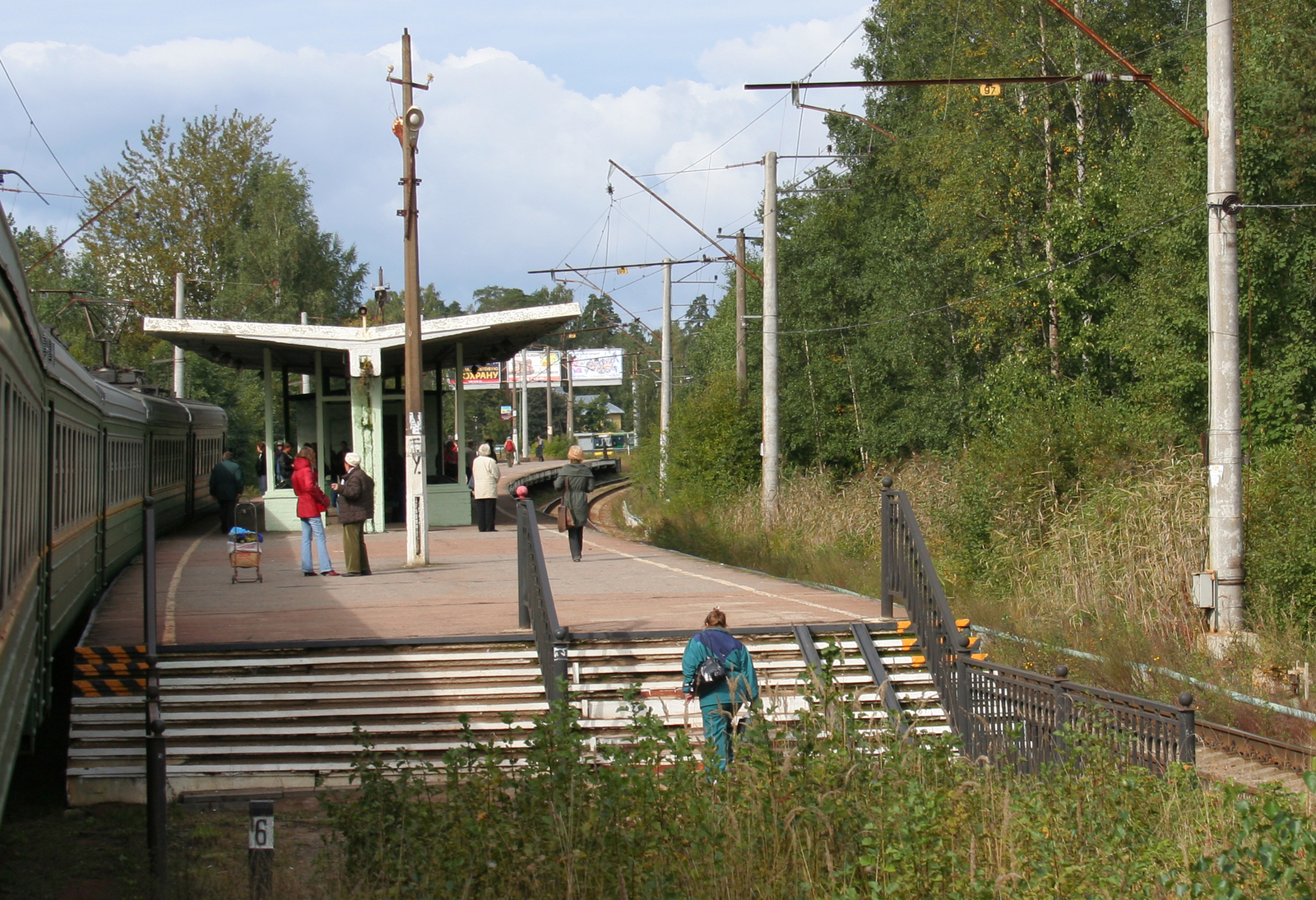
Lisy Nos is the first large station on our way. Unlike platforms, it has additional tracks that allow trains to park here or pass one another. Maybe the train you are riding is also going to wait patiently for a train coming from Sestroretsk to pass. Trains can only pass one another on big stations of this single-track line. If you have to wait a little, pay some attention to a curious peculiarity of this station. Trains coming from Sestroretsk will pass you on the right, not on the left.
