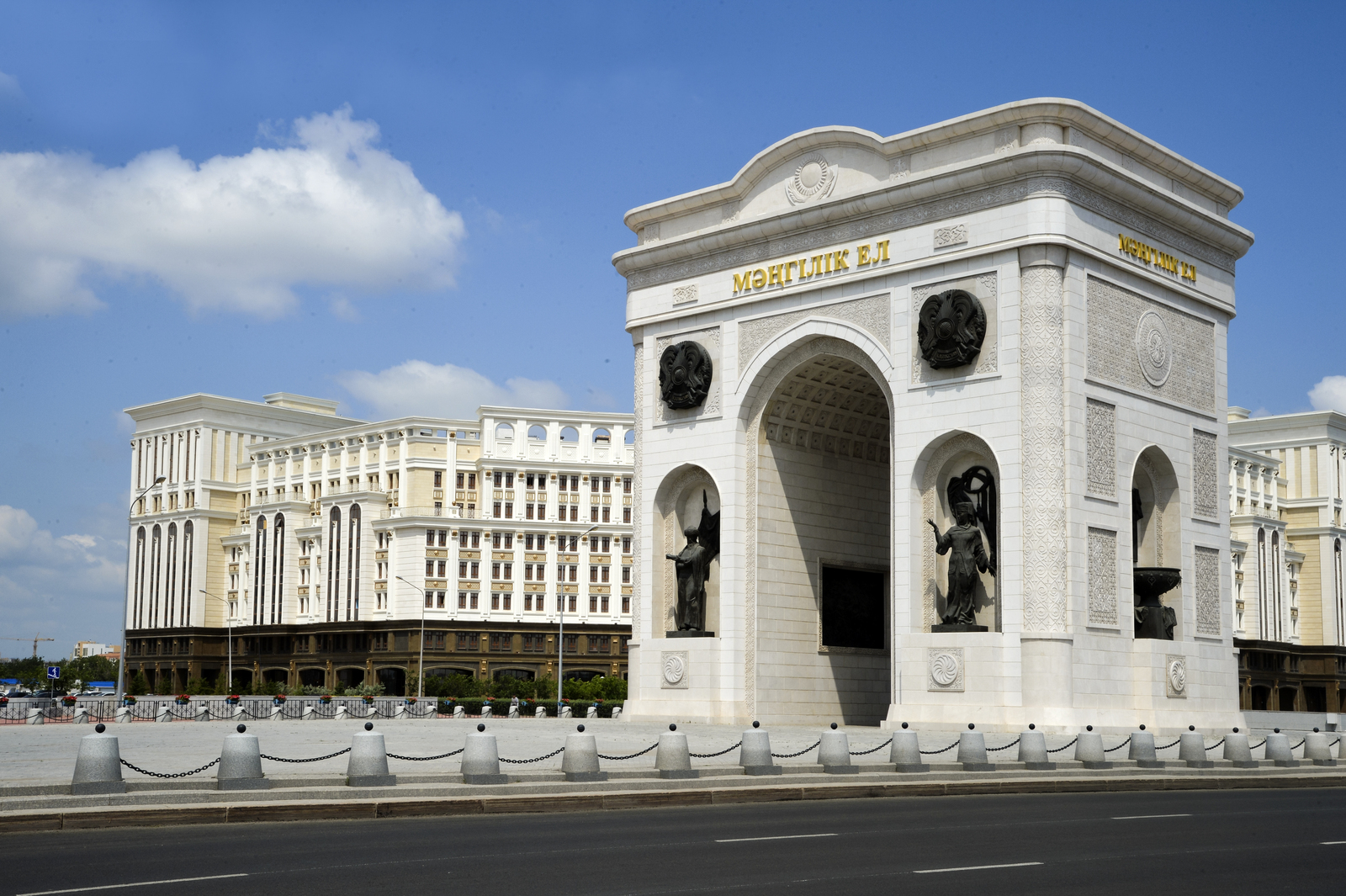
One of the brightest and most symbolic decorations of Astana is the Arc de Triumph. It is located at the intersection of Mangilik El avenue and 25th street. This iconic architectural structure was erected in 2012 on the initiative of the Head of State Nursultan Nazarbayev on the occasion of the 20th anniversary of Kazakhstan's Independence and symbolizes the success of the young republic in the first 20 years of its formation and development. To the left of the arch span is the sculpture of Aksakal - a symbol of wisdom, a carrier of spirituality and thought of the people. Through its image projected such majestic inherent in the Kazakh nation categories as: "Danalyk" "Danyshpan","Gulam".To the right of the arched passage in the niche is the relief sculpture of the Mother Woman, the guardian of the hearth. In the image of Ana, sacred for the Kazakhs, such unshakable values as "Otan Ana" - Motherland-Mother, "Zher Ana" - Native land, "Ana tili" - Mother tongue are intertwined. Under each of the figures is the famous Kazakh solar sign - "Eternity". In the Turkic peoples, the image of the solar sign served as a guard against all the evil and was a source of light, heat, life and good. Here it has one more meaning - the state is eternal, as are the eternal themes of sculptural compositions. At the top of each of the sculptures is the coat of arms of the Republic of Kazakhstan. The emblem gives majesty to the structure, demonstrates exceptional state significance and reveals the fullness of the state symbols. The style of the archway line emphasizes the specific national specifics of the structure: it is not purely eastern, but not absolutely European.On top of the front there is an inscription "Mangilik El". "Mangilik El" has deep historical roots and great semantic value. In the Turkic annals, the word "mangi" (eternal) was often used in parallel with "Tengri", "Kudai", "Allah". In this sense, "Mangilik El" means "Country, the people of the Most High" and is a kind of timeless amulet of the state and nation. At the top of the entire facade composition is a complex ornamental element, which is used in the national flag. And crowns the entire composition of the symbols of the national flag in the form of the sun and the hovering golden eagle. The sun is the source of life and energy. In the language of symbolism, the silhouette of an eagle means state power, breadth and perspicacity. In the world view of the nation, the golden eagle is a symbol of freedom, independence, striving for the goal, for height, for the future. Four corners of the arch are flanked by columns, which emphasizes its classical style. In the niche on the left side is the figure of the Warrior-nomad, and on the right side - the serviceman of the modern Kazakhstani army. The idea of this sculptural group is that the protection of the state is one of the main and sacred values of the Kazakh nation. The figure of a modern young soldier personifies the reliable protection of modern Kazakhstan striving for the future. The side parts also have peculiar niches, where the symbolic figures "Tai-kazan" are located. For the Turkic peoples, "Tai-kazan" has a profound meaning, which reflects unity, hospitality and prosperity. Also, the side walls are decorated with elaborate Kazakh ornaments, where the shield of Kazakh soldiers "Kalkan" is located in the center of the upper part. The shield at all times symbolized protection from threats, reliability, fortitude, victory. "Kalkan" forms a stable associative series - "Batyrlyk", "Erlik". Inside, the arched opening on both sides is decorated with relief panels measuring 5.2 x 3.5 meters each. The plot line of one of them reflects the development of the history of the Kazakh nation in the symbolized periodization of "Saki" - "Türks" - "Kipchaki" - "Kazakhs". The main theme is the "Uly Kesh", reflecting the basic philosophy of the nomadic civilization and signifying the progress and development. On the other hand, the theme of the panel is devoted to the main value of the nation - Independence. Inside the arch, while climbing, along the stairs, there are landscape, reportage and genre photographs telling the visitors the history of the capital: Bozok - Akmolinsk - Tselinograd - Akmola - Astana. In the upper part of the arch there is a hall of periodic exhibitions and a multimedia exhibition. After getting acquainted with the multimedia exposition and the exposition of the exhibition hall, having overcome 30 steps, it is possible to climb to the observation deck, from which you can see the Avenue Mangilik El and its surroundings. The height of the architectural design allows you to be on the dominant position and retain visibility along the entire length of Mangilik El avenue. In front of visitors, as in the palm of your hand, you can see the panorama of the square itself.

Click to see all 2 Photos
Story 8 years ago
"Mangilik Yel" Triumphal arch
ТЦ
ТОО "Центр развития Астаны"
en
Overview
Reviews 0
Reviews
0.0
0 comments
Provided by
ТЦ
ТОО "Центр развития Астаны"
This story belongs to
5.0