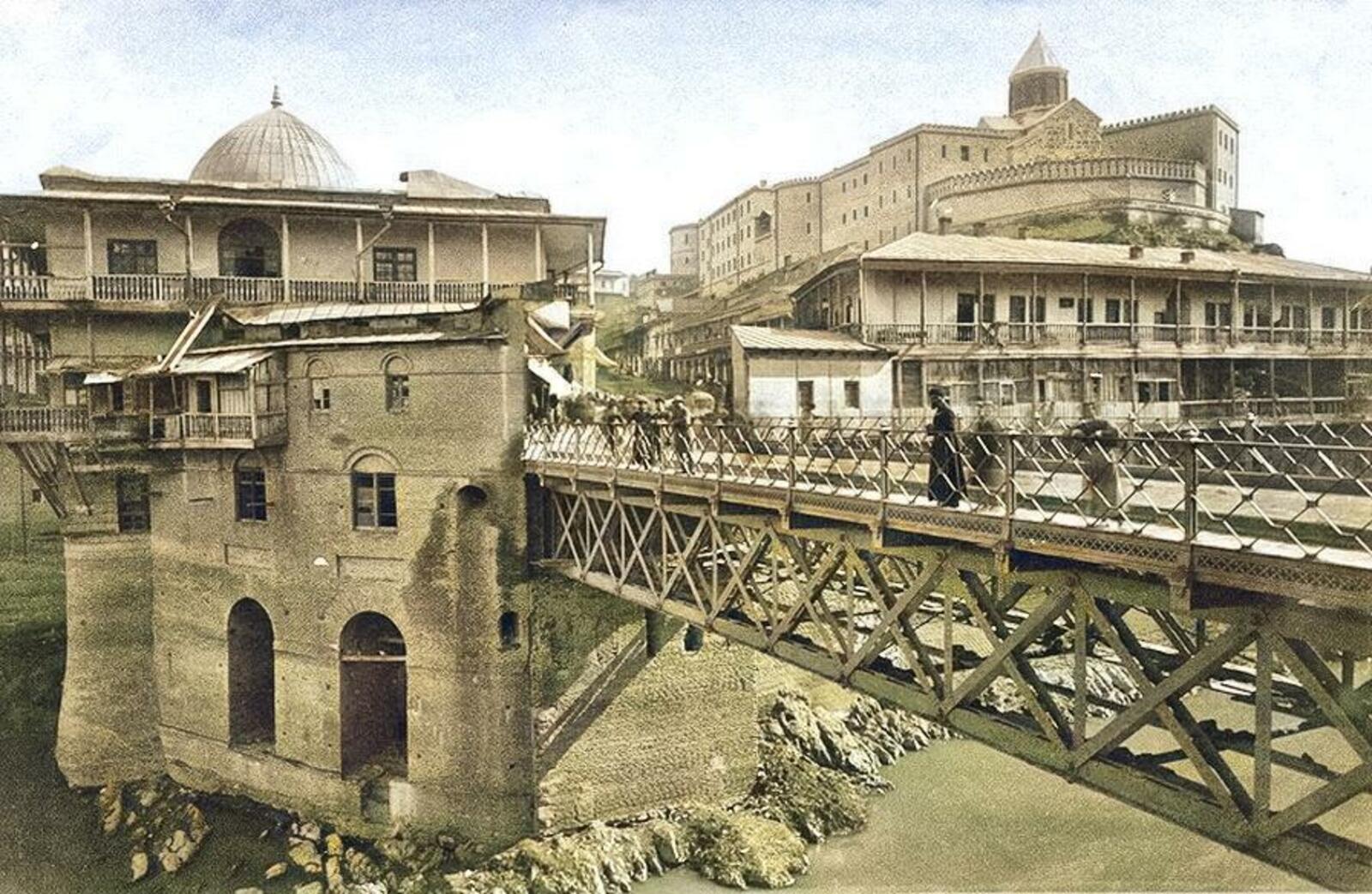


Considering that the Mtkvari River divides Tbilisi into two parts, a link was indispensable to connect both sides of embankments. Because the present location of Metekhi Bridge is a site where the two embankments of the Mtkvari are the closest, for centuries the location was the preferred place for laying a bridge.
In 1805, two new bridges – Metekhi and Avlabari – were built side by side on this location. The territory around the bridge housed shopping and storage buildings as well as the Shia Shah Abbas Mosque. In the middle of the 20th century, reconstruction works implemented by the Communists required the demolition of several interesting buildings in the surrounding area, such as Abo Tbilieli’s niche, Shah Abbas Mosque, and the overlooking prison at Metekhi church – all sites that could have been transformed into major highlights for tourists. During the reconstruction of the site, it was decided to leave a single larger bridge instead of two smaller bridges, and this is how the present Metekhi Bridge came to be.
The most recent change to the bridge’s history happened in 2014, when it was renamed 100,000 Martyrs Bridge. The renaming initiated by the Georgian Orthodox Church was quite controversial. On one hand it was to commemorate those citizens of Tbilisi who in the 13th century bravely fought Khorezmian Shah Jalal-ad-Din and declined to convert to Islam after which they were executed and thrown over the bridge. On the other hand, it is hardly believable that 100,000 people could have been killed in Tbilisi during a single day when it took the NKVD three months to execute up to 30,000 Polish officers in Katin in 1939 with the aid of modern technology. Not surprisingly even nowadays the bridge is still called Metekhi Bridge rather than the 100,000 Martyr’s name.