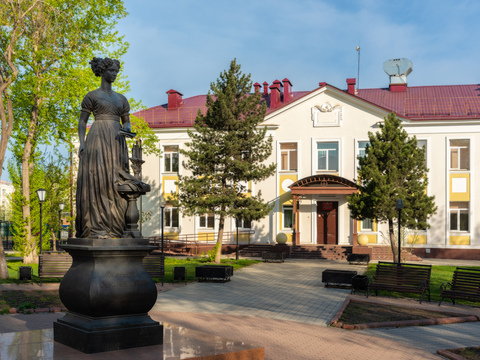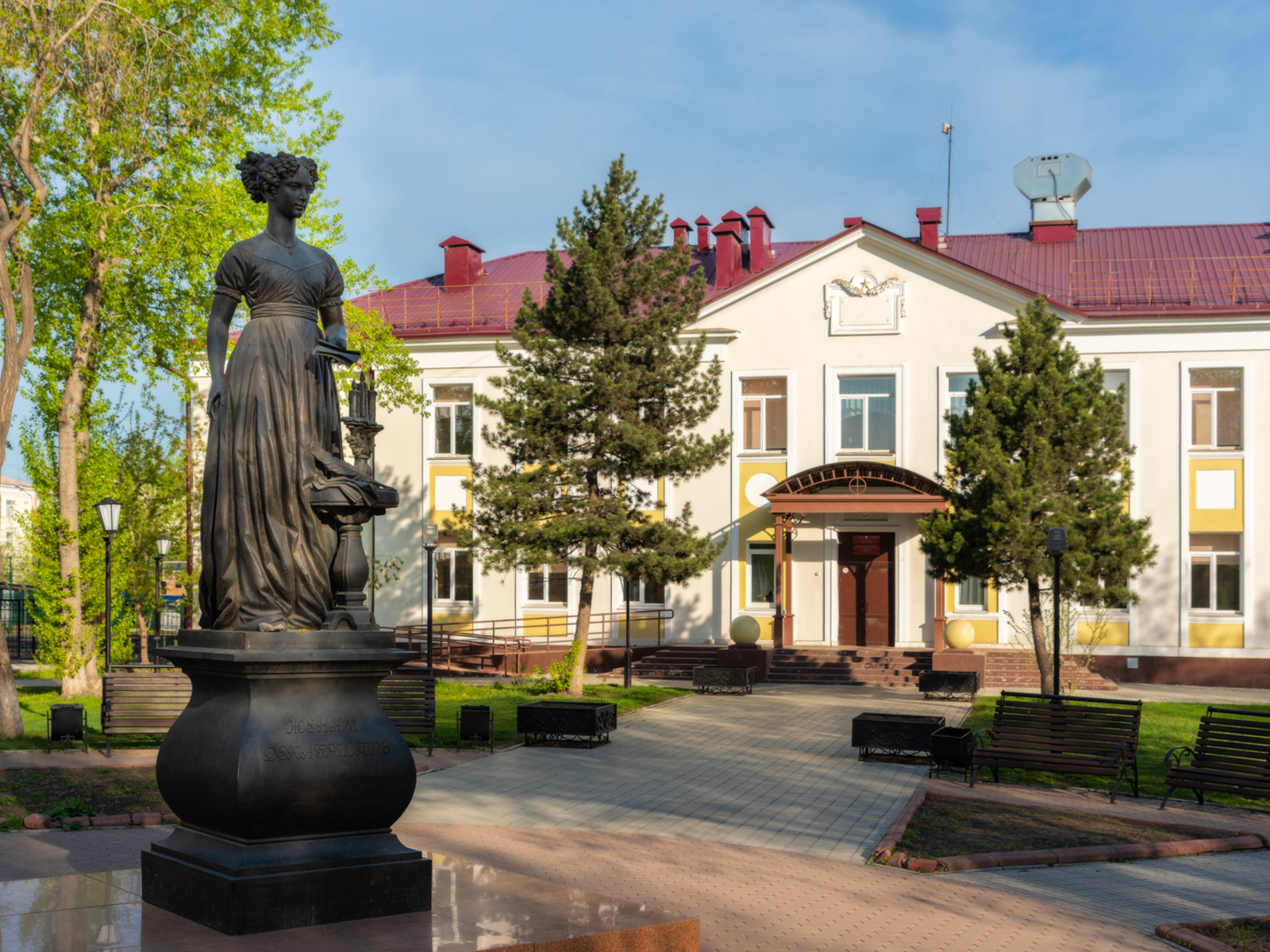

This monument has a symbolic meaning and is dedicated to wives who self-alienated themselves and followed their husbands to Siberian exile. The author of the sculpture chose Maria Nikolaevna Volkonskaya as a prototype of the monument.121 people were sentenced to exile in Siberia for the participation of the Senate Square rebel in St. Petersburg in 1825. Only 23 of them were married. 10 wives and 2 brides followed their husbands to Siberia. According to the Emperor's statement they were deprived of their noble privileges, civil, inheritance and property rights, their families could not support them. Mothers were not allowed to take children with them. In Siberia, they had to stay in peasants' huts. They were allowed to see their husbands only twice a week in the presence of a prison guard. They couldn't move freely and any correspondence was forbidden. There are two known families of Decembrists in Irkutsk: those of Volkonskiy and Trubetskoy. The duchess Maria Nikolaevna Volkonskaya (nee Raevskaya) was born in 1804 in Kiev Gubernya. His father, General Nikolai Raevskiy, was a hero of the Civil War of 1812. Maria married Sergei Grigorievich Volkonskiy in 1852. He participated in the Civil War too and had a title of Major-General. He later became a Decembrist. He was 16 years older than his wife. After his conviction, Maria followed him to Siberia leaving their 2-year old son with her relatives. She shared burdens with her husband who was sent to Transbaikalia (1827–1937). They were later allowed to move to Irkutsk Gubernya. They stayed in Urick village (1837–1845) and in Irkutsk (1845–1856). They had their own house in Spaso-Preobrazhenskaya Church homestead. They had three more children in Siberia. In 1856 the family finally moved to Moscow. Maria spent her last years in Voronki manor in Chernigovskaya Gubernya. She died in 1863 and her husband passed away in 1865. Ekaterina Ivanovna Trubetskaya (nee Laval) was born in 1800 in St. Petersburg in the family of an influential state official and a French immigrant – Jean Laval. She married Sergei Petrovich Trubetskoi, a colonel and a Civil War participant and a successful officer of Russian Army in 1820. He later became Decemrist. The husband was 10 years older than the wive. After his conviction, she got the permission to follow him. Trubetskoy's family stayed in Transbaikalia in the period of 1826-1839. They were later allowed to move to Oiek village of Irkutsk, in 1845 they moved to Irkutsk. They had the house near Volkonskiy family, together they became the center of cultural and friendly meeting of other Decembrists in exile. Trubetskoy family had 7 children in Siberia, despite the first barren years of their marriage. Three children died when they were too young and 4 others lived for quite a long period of time. The passed away children are buried with their mother in 1854 in the yard of Znamenskoye Abbey. The monument to Decembrists Wives is located in the yard of Volkonskiy's house, it was installed in 2011 to commemorate the 350th anniversary of Irkutsk. Sculptor Mikhail Periaslavets and architect Yuri Volchok were the authors of this project. It was recognized as the best in the creative contest of the year 2009. The monument was created in Zhukovskiy (a city near Moscow) with the money of Irkutsk entrepreneur Victor Zakharov.