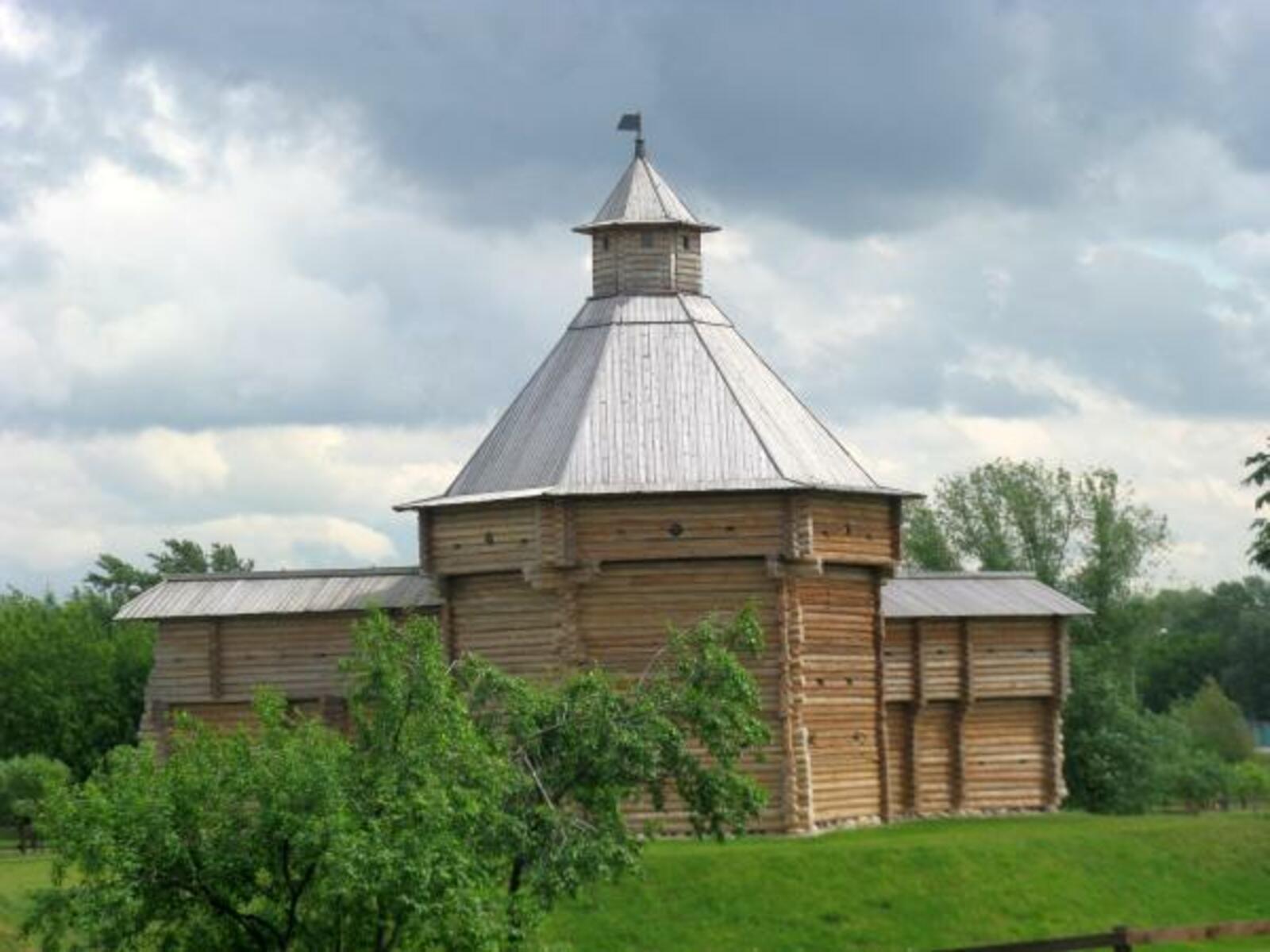

If you stand facing the entrance to the Nikolo-Korelskii monastery then to the left there is the Moss Tower of Sumsk stockade. It is angular and at the top there is a flag not a cross.
The Bratsk stockade tower stands separately. Small and solitary. It really is smaller than the Moss tower and the monastery gates.
The Sumsk stockade stood on the banks of the White sea and like most other Russian fortresses of the 16th and 17th Centuries, was wooden. Russian craftsmen perfected fortress building. For example, the walls and towers of the Sumsk stockade could resist attack even from cannons.
The Moss – northwest – tower of the Sumsk stockade was constructed in the 1680s. And it stood for almost 250 years without any reconstruction. And when in 1931 it was decided to restore the now dilapidated tower Peter Baranovskii brought the Moss tower to Moscow.
For many years the disassembled Moss tower was stored in the memorial estate. Finally, in 2003 restorers made a full reconstruction of the monument. And they did it according to descriptions and drawings which were made by Peter Baranovskii. Even fragments of walls adjoined to the tower were preserved.
By the way, in the European part of Russia there has been no example of wooden defensive architecture for a long time. So the historical and architectural value of the Moss tower is very high.
You should get closer and see that there still remain traces of Swedish cannon shot. In 1613 the stockade was besieged by the Swedish armies, but they could not capture it.
The Bratsk stockade tower stands separately. Small and solitary. It really is smaller than the Moss tower and the monastery gates.
The Sumsk stockade stood on the banks of the White sea and like most other Russian fortresses of the 16th and 17th Centuries, was wooden. Russian craftsmen perfected fortress building. For example, the walls and towers of the Sumsk stockade could resist attack even from cannons.
The Moss – northwest – tower of the Sumsk stockade was constructed in the 1680s. And it stood for almost 250 years without any reconstruction. And when in 1931 it was decided to restore the now dilapidated tower Peter Baranovskii brought the Moss tower to Moscow.
For many years the disassembled Moss tower was stored in the memorial estate. Finally, in 2003 restorers made a full reconstruction of the monument. And they did it according to descriptions and drawings which were made by Peter Baranovskii. Even fragments of walls adjoined to the tower were preserved.
By the way, in the European part of Russia there has been no example of wooden defensive architecture for a long time. So the historical and architectural value of the Moss tower is very high.
You should get closer and see that there still remain traces of Swedish cannon shot. In 1613 the stockade was besieged by the Swedish armies, but they could not capture it.