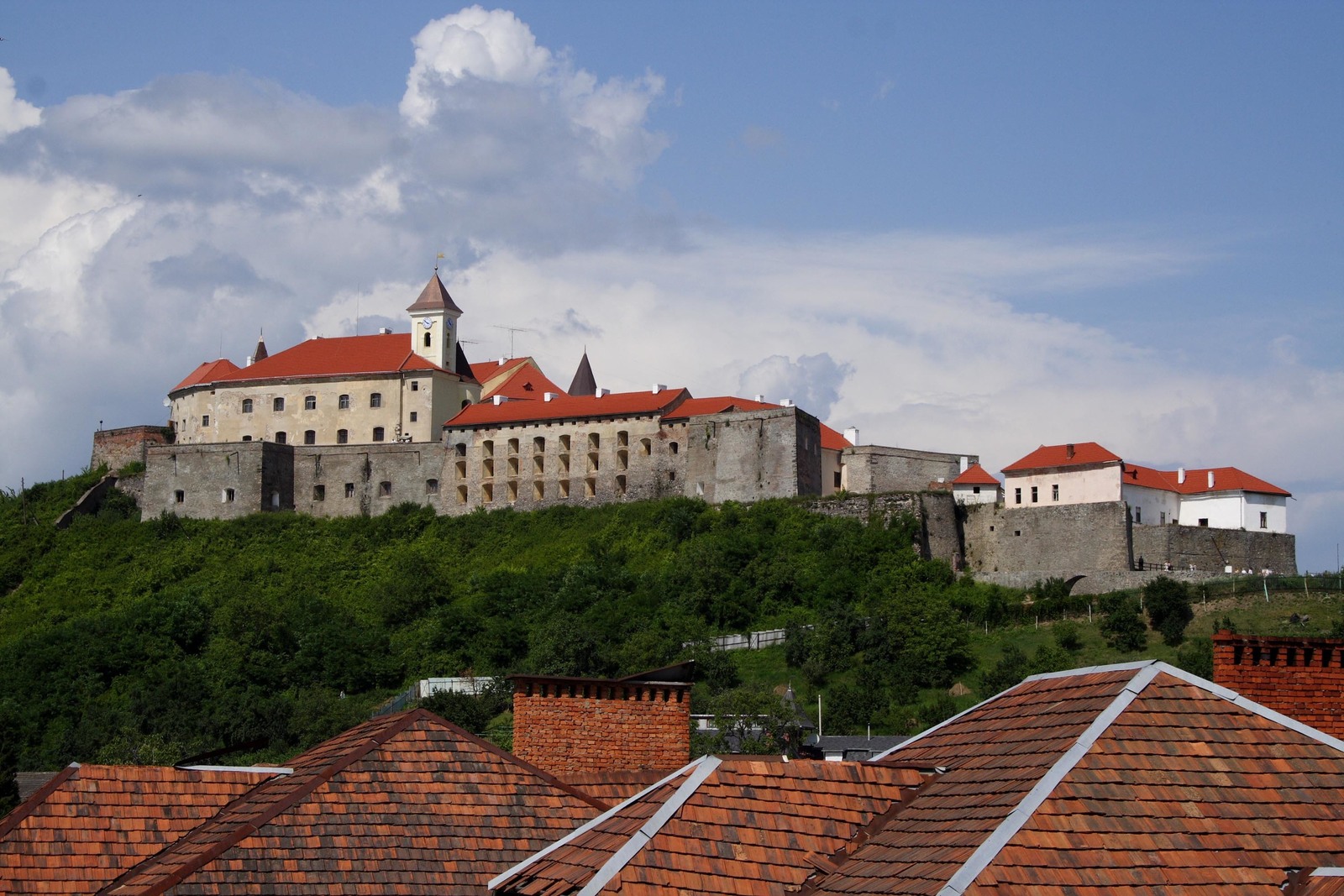

Mukachevo Castle is one of the most powerful and magnificent fortresses in Ukraine. Being an architectural gem of Zakarpattia, the castle has survived several epochs and now draws tens of hundreds of tourists annually.
Another name under which Mukachevo Castle is known is «Palanok». It began to be used only in the 1920s during the times of Czechoslovakia. The name came from the village of Várpalánka (literally, «var» means «suburb», and «palanka» means «a fortified place»).
Mukachevo Castle was built on the mountain, which is an extinct volcano. The first mention of the fortress dates back to the 14th century. In 1311, after the assassination of the magnate Amadeus Aba in Košice, King of Hungary Charles Robert of Anjou confiscated a number of his possessions, including the castle in Mukachevo.
Until the end of the 14th century, the fortress was owned by the Crown. Later, its owners were Fedor Koriatovych, Serbian despots Stefan Lazarevic and George Brankovic, as well as the Hunyadi family. In the late 15th century the fortress returned to the Crown.
In 1528, Janos Zapolyai became the new owner of the estate, appointing Mihai Biudi as the commander and governor of the comitat of Bereg. During Biudi’s governing, the most famous master counterfeiter of the 16th century, Miklos, worked in the castle for some time.
Over the next century, Mukachevo Castle underwent a change of ownership. Eventually, in 1633, the fortress passed to the Rakoczi family. During the reign of Rakoczi, the castle was rebuilt and modified, in particular, a moat was dug around the foot of the Castle grounds. After a while, a representative of the Rakoczi family – Ferenc I married Ilona Zrinyi, the daughter of the Croatian ruler. The most victorious pages of the history of Mukachevo Castle are connected with her name.
When Ferenc I Rakoczi died, Ilona Zrinyi continued her husband’s liberation struggle against the Austrian Crown, leading the anti-Habsburg movement. In 1682 she remarried to the Hungarian Count Imre Tekeli, who was 14 years younger than her. The wedding took place in Mukachevo Castle and lasted 8 days. And in 1685 the Austrian troops began the siege of the fortress which lasted for 2.5 years. In 1703-1711 the fortress in Mukachevo was one of the centers of the national liberation war, led by Ferenc II Rakoczi, the son of Ilona Zrinyi.
After the defeat of the anti-Habsburg movement, Mukachevo Castle became the property of the Austrian Crown. During this period, the fortress underwent significant modernization: some of the towers were dismantled, bastions and semi-bastions were built in their place and they have survived to this day.
In 1722, after the first partition of the Polish-Lithuanian Commonwealth, with the spread of Austrian rule and the shifting of the border, the fortress in Mukachevo lost its strategic importance. In 1787, most of the cannons were removed from the castle, and a few years laters the first prisoners appeared here. From 1782, the political prison of the Austrian monarchy was situated inside the fortress. All those, who dared to go against the will of the Crown, were placed there. The prison in the castle was abolished in 1896 in honor of the arrival of Magyars in Europe.
In June 1834, a large fire in the castle destroyed the outbuildings and furnishings of the chapel. At the insistence of the governor of Kosice, repairs were made to the fortress after the fire.
On April 29, 1915, in Zakarpattia, the first public celebration related to T. H. Shevchenko took place on the terrace of Palanok. About a thousand shooters and many guests from Mukachevo and the surrounding area gathered at the event.
In the Soviet period, a barbaric restoration began in the castle in 1973, during which the commandant’s house was dismantled and the upper chambers were looted.
With the advent of Independence, in 1996, a monument to Fedor Koriatovych was installed in Palanok. In 2006, a sculpture of Ilona Zrinyi with her son Ferenc and a clock on the tower appeared here. In 2008, speleologists cleaned the well and installed the Turul. «The turul» means «a falcon».
By the way, be sure to stop at the statue of Fedor Koriatovych, take it by the finger and make a wish. It is said that the bronze prince will grant even the most secret wish during the year, so do not miss this opportunity.