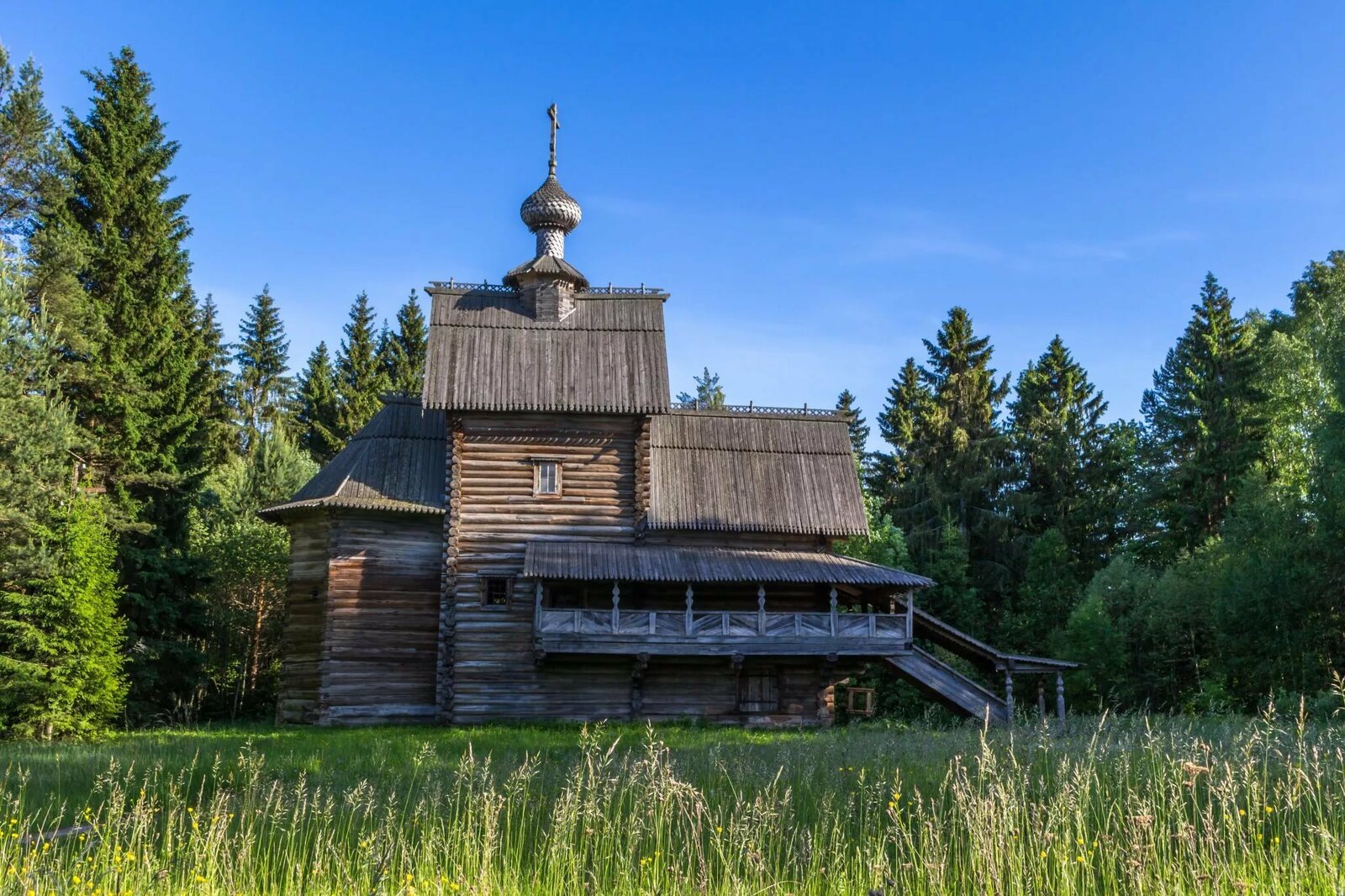

In the open air of the Tver region there is a unique architectural and ethnographic museum "Vasilevo." The same name is given to the village where it is located. A wonderful exposition of examples of Russian wooden architecture was located on the territory of the Lvov estate.
But perhaps we need to start from the very place. Vasilevo is a village on the banks of the Tvertsa River in the Torzhkovsky district. Here stands the Lvov’s estate, a Tver nobleman, inherited from him from another Lvov, the hero of the Chigirinsky campaigns. By the way, the house was designed by Nikolai Alexandrovich Lvov, the famous architect of the late 18th - early 19th centuries. Now there is nothing left of the manor building, the fire destroyed everything except the remains of the concrete. But we have the happiness of observing a two-story outbuilding, where a greenhouse was previously built, on the second floor of which peacocks walked. An old linden alley has been preserved from the park ensemble (previously the crown of these trees was trimmed in such a way that they created an arched passage, it seemed that you were getting into a green tent). Also, three ponds built in a cascade on a stream were saved from the park. Elegant dams are made of boulders, and above the water flow in a semicircle there is a hundred-meter arched bridge assembled from stones. A wonderful feature of this bridge are grottoes. The boulder ensemble is called the "magnificent stone symphony." The entire estate is a magnificent example of a "noble nest."
The Museum of Wooden Architecture in Vasilevo was created in 1976, then it was a state ethnographic museum. From different places in the Tver region, real masterpieces of wooden art of buildings of the 18th-19th centuries were brought here. It is divided into two parts. The first is the Lvov estate, about which we have already told, and the second is peasant. It reveals to us all the beauty of Russian wooden architecture.
The open-air exposition shows us not only the architecture, but also the life of the Russian village of the XVIII-XIX centuries. More than two dozen unique wooden monuments are collected here. Znamensky church of 1742 with two altars, the chapel of Archangel Michael of the middle of the 18 century, the chapel of the Assumption of the Mother of God, farm, and household buildings, a well and a two-story tavern of the late 19th century. There is even a fire station in 1912, which was delivered from the village of Laptikha, Bezhetsky district. Also, we cannot mention, the magnificent small church of the Transfiguration of 1732. This is a wooden church of the cage type, was delivered from the deaf marshes of the churchyard of Spas Na Sozi, consists of an altar, the main room, a refectory, and a hanging gallery.
There are other interesting exhibits on the territory of the museum. You will find here unique boulders, ancient cult stones of the early Christian period with an imprint of the foot of the Virgin and drawings of the cross.
Vasilevo Museum is a wonderful combination of wonderful natural landscapes, old estate and Orthodox buildings.