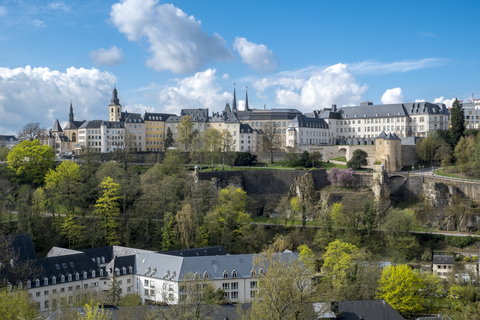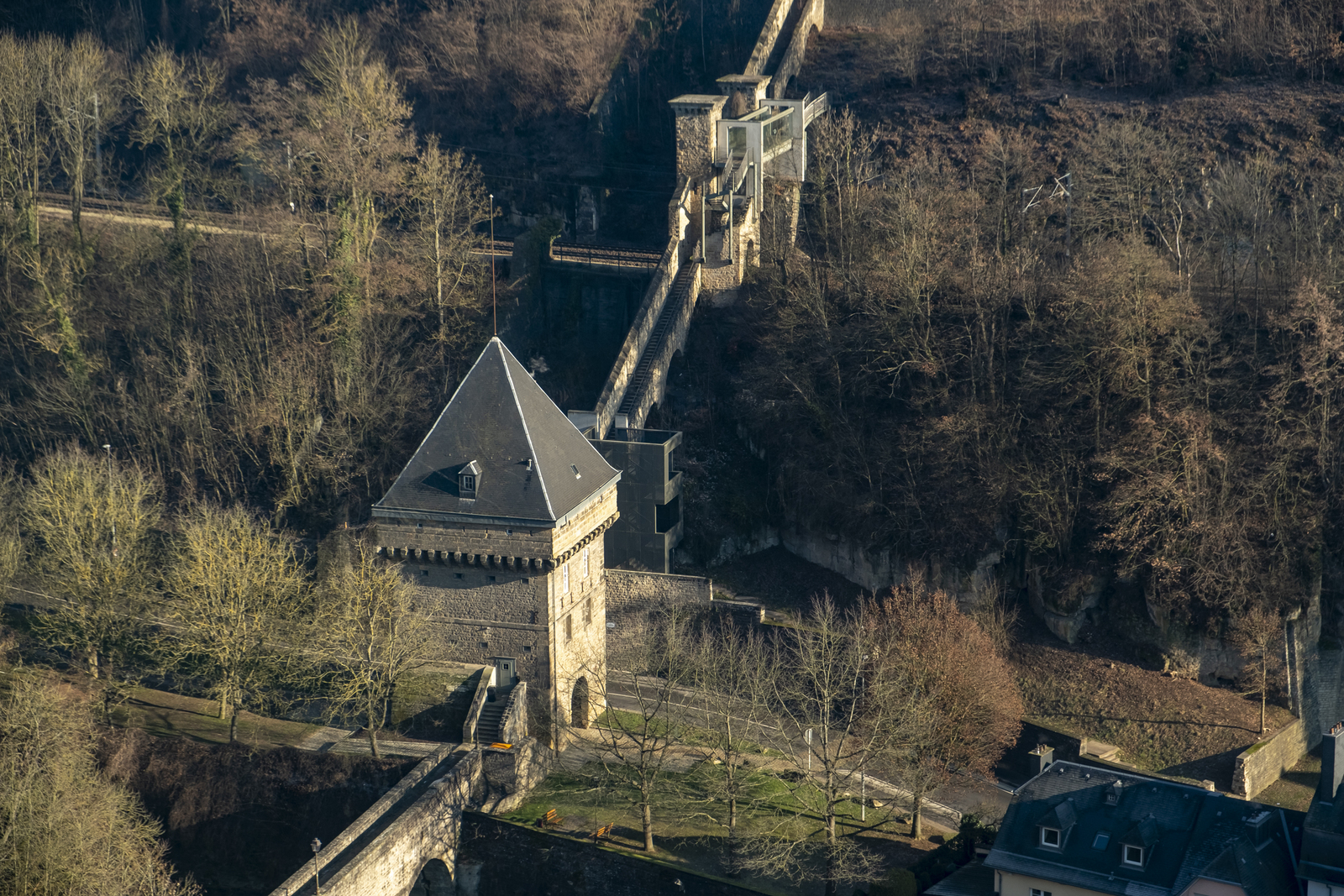


A UNESCO world heritage buffer zone, Pfaffenthal has played an important part in the history of the Luxembourg fortress since Vauban incorporated it in the fortifications in 1865. On the “Vauban Circuit”, leading up to the forts in the Grünewald, many remains can still be seen, for example, the Eich and Bons Malades Gates, which were once defended by deep trenches, heavy drawbridges, and loopholes. If the enemy managed to get close they could be bombarded with molten tar or oil, poured through openings. in the gallery above the arch. Doors on the upper level led to the defensive walls. A further, arrow-shaped fortification was built in 1743 to defend the trench in front of the Porte d'Eich. The tall chimney beside the river is what remains of an old pumping station that brought water to the upper town. Between the two Vauban Towers is a defensive wall-walkway (called “De Béinchen”) that crosses the Alzette River. A film showing the history of this neighbourhood is projected in a loop in the Bons Malades Tower. More recently, in 1976, this was the site of a tragic explosion caused by the mishandling of liquid fuel. Three people died and 21 were injured in the incident, which also caused substantial damage to property. The area was restored in 1982 and 1986.
Opposite stands St Mathew’s Church, built in 1871/2 in the Byzantine style by the state architect Charles Arendt. Inside is a magnificent painting attributed to Gaspard de Crayer (1584-1669). The site is also noteworthy because six members of the resistance hid for a time in the loft above the side nave during World War II. Today the church is used by the orthodox community.
Further down the valley, as we leave the UNESCO zone, is the Pfaffenthal-Kirchberg railway station and funicular (2017), which links the lower town to the rail network and the Kirchberg European and business district. Here cyclists can choose between taking the PC2 cycle-path to Echternach or the PC4 towards the Moselle River.
To the left of St Mathew’s Church is the “Théiwesbuer”, a spring from which water was taken and brought to the upper town. Before pumps were installed, this was mostly done manually. Opposite, underneath the bridge, was a washhouse which was converted into a paddling pool in 2017. The water is a constant (if chilly) 12°C (54F).
Another 100 m (325ft) from the Pfaffenthal-Kirchberg station is the historic Val des Bons Malades cemetery. It includes tombs of “Communards” (members and supporters of the 1871 Paris Commune), a French memorial monument (1870), and a funeral monument in honour of the Luxembourgish composer Laurent Menager. Dominating the valley is the Grand Duchesse Charlotte Bridge, commonly called the “Red Bridge”. It was built in 1962 to the plans of the engineer Egon Jux and opened to traffic in 1967. It links the Kirchberg European and business zones with the Limpertsberg district and the upper town. It is 355m (1,165ft) long and its steel construction stretches 75 m (245ft) high over the Alzette. This sophisticated structure illustrates the level of engineering know-how in this country in the 1960s.