

Polish aristocrat Count Casimir Pulaski (in his native language, Kazimierz Pułaski) was one of several “soldier of fortune” European military officers who came to aid the U.S. during the War for Independence. Other key foreigners were Pulaski’s countryman, Thaddeus Kosciusko, the Marquis de Lafayette (France), Baron Friedrich Wilhelm von Steuben (Prussia), and Baron Johan De Kalb (Bavaria). The latter commanded the famed “Maryland Line” of the Continental Army for much of the war. And guess it what? It was none other than the wily old diplomat Ben Franklin who arranged to come to help the new United States. When you know that fact, you begin to realize what we owe to the “Fathers of Our Country”!
After years fighting the Russians occupying his native land, Pulaski was forced to quit his homeland. Sentenced to death by the Tsar, he fled to Paris where Franklin and Lafayette recruited him to join the struggle for Independence.
Pulaski soon gained the nickname “Father of the American cavalry.” He became known for his bravery and keen military mind. In 1777, at the Brandywine near Chadd’s Ford just over the Mason–Dixon Line in Pennsylvania, he saved Gen. Washington’s life and the grateful commander-in-chief promptly promoted him to brigadier general. Unfortunately, due to Casimir’s lack of English, he shortly had to give up the appointment. Washington named him instead his Army’s “Commander of the Horse”—the position he held until his death at the siege of Savannah, Georgia in 1779.
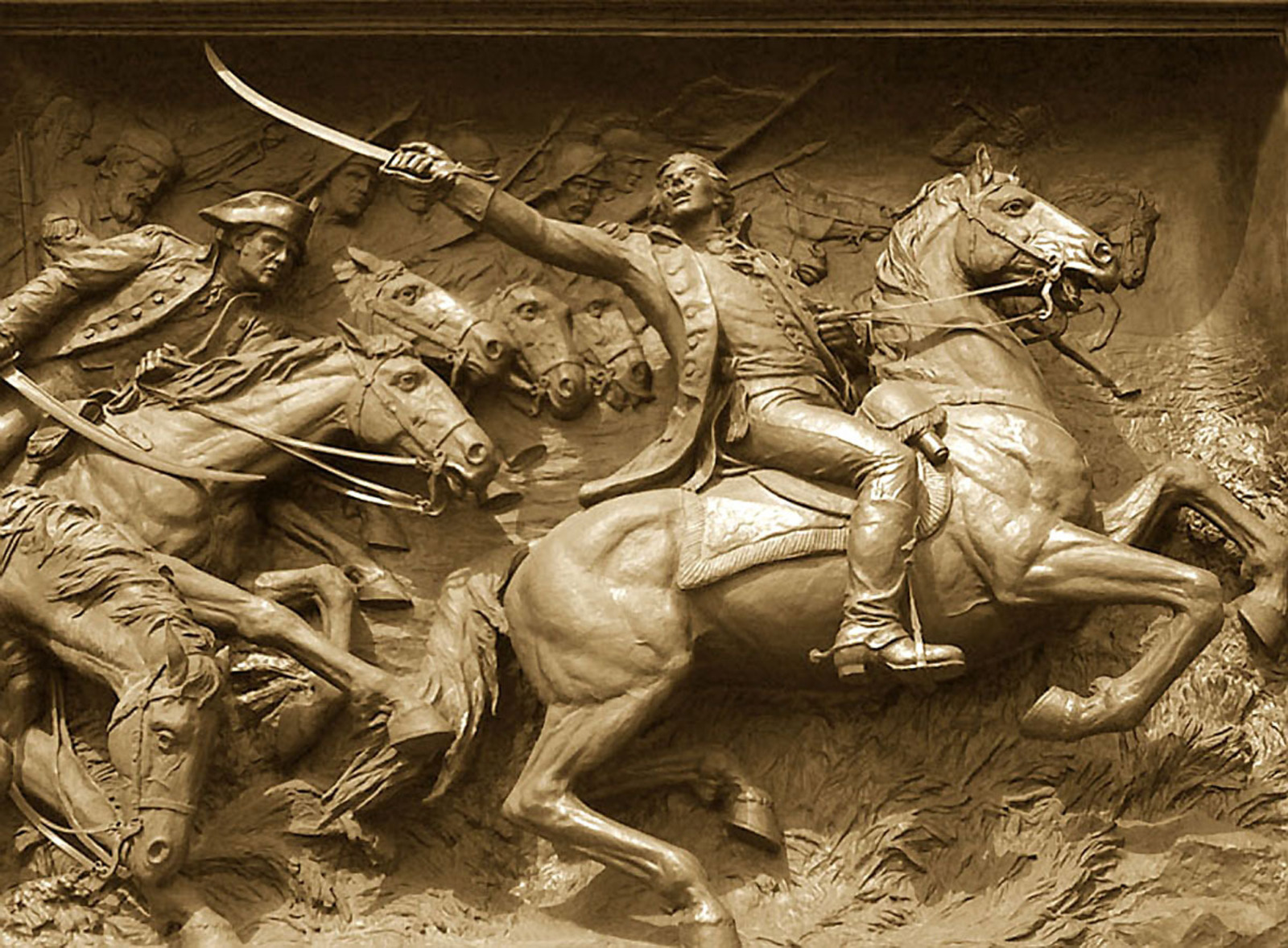
This sculpture, by noted local artist Hans Schuler and architect A. C. Radziszewski, depicts Pulaski and his aide, French-born Capt. Paul Bentalou, a Baltimore merchant in peacetime, leading the cavalry on October 9, 1779. The brave Polish cavalry commander was struck by an enemy projectile in the thigh. He died from his wound two days later. Both Pulaski and De Kalb gave their lives in the cause of American freedom.