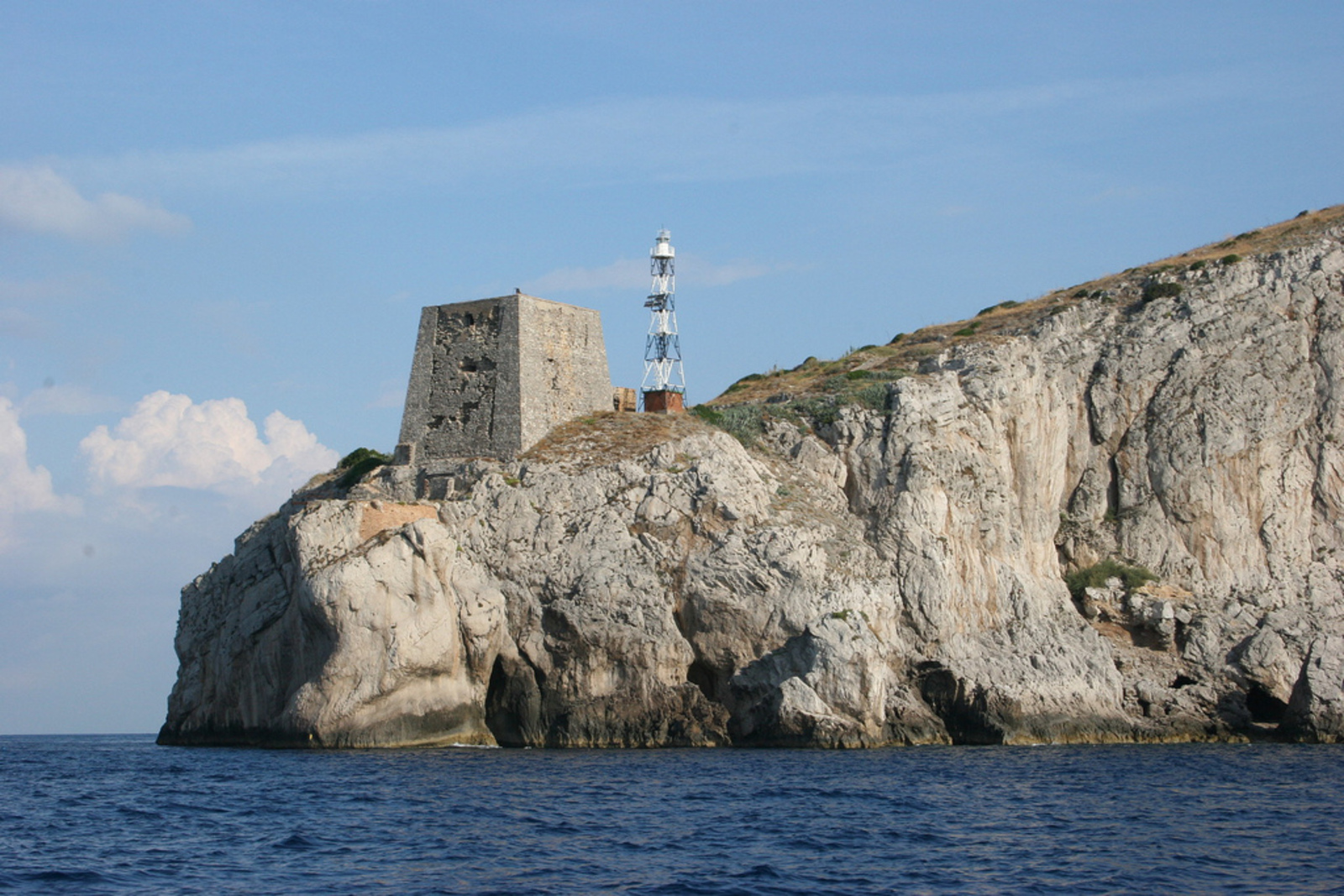
Punta Campanella is located in the Gulf of Naples and that of Salerno within the Termini hamlet of the municipality of Massa Lubrense (NA). Since 12 September 1997, the protection of marine biodiversity is from the Protected Marine Area of Punta Campanella which extends along the coast for 31 km from Punta Capo di Sorrento to Punta Germano including the Vervece rock, Vetara and the Li Galli islands.
One of the most unique tales, between the real and the fantastic, concerning the coast of Punta Campanella is the legend of the pirates and the bells. It is said that the Saracens sacked the coasts, robbing small and large bells from the numerous chapels and churches in the area. They stole them to avoid any future ringing, a signal from the alarm of their arrival and to melt the bronze used for the construction of cannons. One of these thefts was unsuccessful due to the strong sea currents between Punta Campanella and Capri where to save the Saracen boat, too loaded by the weight of the huge bell of the church of Sant'Antonino Abate (patron of Sorrento) forced to throw the bell overboard. Since then, you can hear the bell between the rocks at the bottom of the sea when the libeccio wind is strong.
The promontory of Punta Campanella with the homonymous tower, also known as the Minerva tower, from the name of an ancient temple that once stood in this area.
Strabo, a Greek historian, tells us that here there was one of the most famous sanctuaries of the Tyrrhenian coast dedicated to Athena (Greek name of Minerva), protector of sailors, whose foundation is attributed to the mythical Ulysses.
In ancient times, when ships passed in front of the temple, they poured fine wine into the sea as a sign of respect for the Goddess.
Ulysses, a Greek hero, it is said that having crossed the waters around the Li Galli islands unharmed, a place populated by Sirens (legendary creatures with the body of a bird and the face of a girl), he wanted to thank Athena by dedicating the Temple to her.
At the end of the 5th century BC the Osco-Samnites, an Italic population from the central Apennines, occupied the entire area of the peninsula, as confirmed by an epigraph in the Oscan language, datable to the III - II century. B.C. recently discovered (1985).
(The inscription mentions three Meddices Minervii, an Oscan expression for "Magistrates of Minerva", who would have taken care of the work for the construction of an entrance staircase to the sanctuary) The inscription, still visible on the ancient staircase leading to the sanctuary, mentions three Meddices Minervae (magistrates of Minerva). This attests that Athena's culture was also maintained by the Osci, who had changed its name to Minerva. From the end of the fourth century. B.C. Roman penetration began which brought about a significant change in the urban layout of the whole area. There were numerous villas of aristocratic families attracted by the coastal views and by the transfer to the beautiful island of Capri of the imperial court of Tiberius from 27 to 37 AD.
This territory was particularly loved by the Roman patricians, such as Pollio Felice, patrons of the poets Virgilio and Orazio, who had an imposing villa built right at the head of Sorrento.
The remains of other rich Roman patrician residences are still visible in Massa Lubrense, Punta Campanella, Crapolla and the Li Galli islands, where Tiberius loved to go with his court and his Aedi in the hope of being able to hear the song of the Sirens.
Subsequently, the crisis of the Roman Empire led to a gradual abandonment of the area and of the numerous villas that were transformed into farms.
From this period the Campania coasts saw the presence of the Saracens; Later the Normans, to try to stem the danger of their raids from the sea, created a first coastal defensive system, adapting old Roman traffic light towers positioned along the coast to signal enemy boats.
The tower of Punta Campanella was built by Robert of Anjou in 1335, at the expense of the towns on the northwestern side of the peninsula to defend the Saracen invasions and to prevent the underlying cave from being used as a hiding place by pirates. Located in a strategic place, in 1558 it was almost completely destroyed by the Turks and later rebuilt.
It is precisely this tower that gives the tip its name, since in all probability, a bell was placed inside it, an acoustic aid to the luminous danger signals.