Noble Park – covering one small city block adjacent to the beach, welcomes all, from tightrope walkers to dogs and almost everything in between. How did Hermosa Beach planners arrive at a park for such a prime piece of beachfront real-estate? The answer is a long strange journey and one part of Hermosa History that’s sure to surprise anyone.
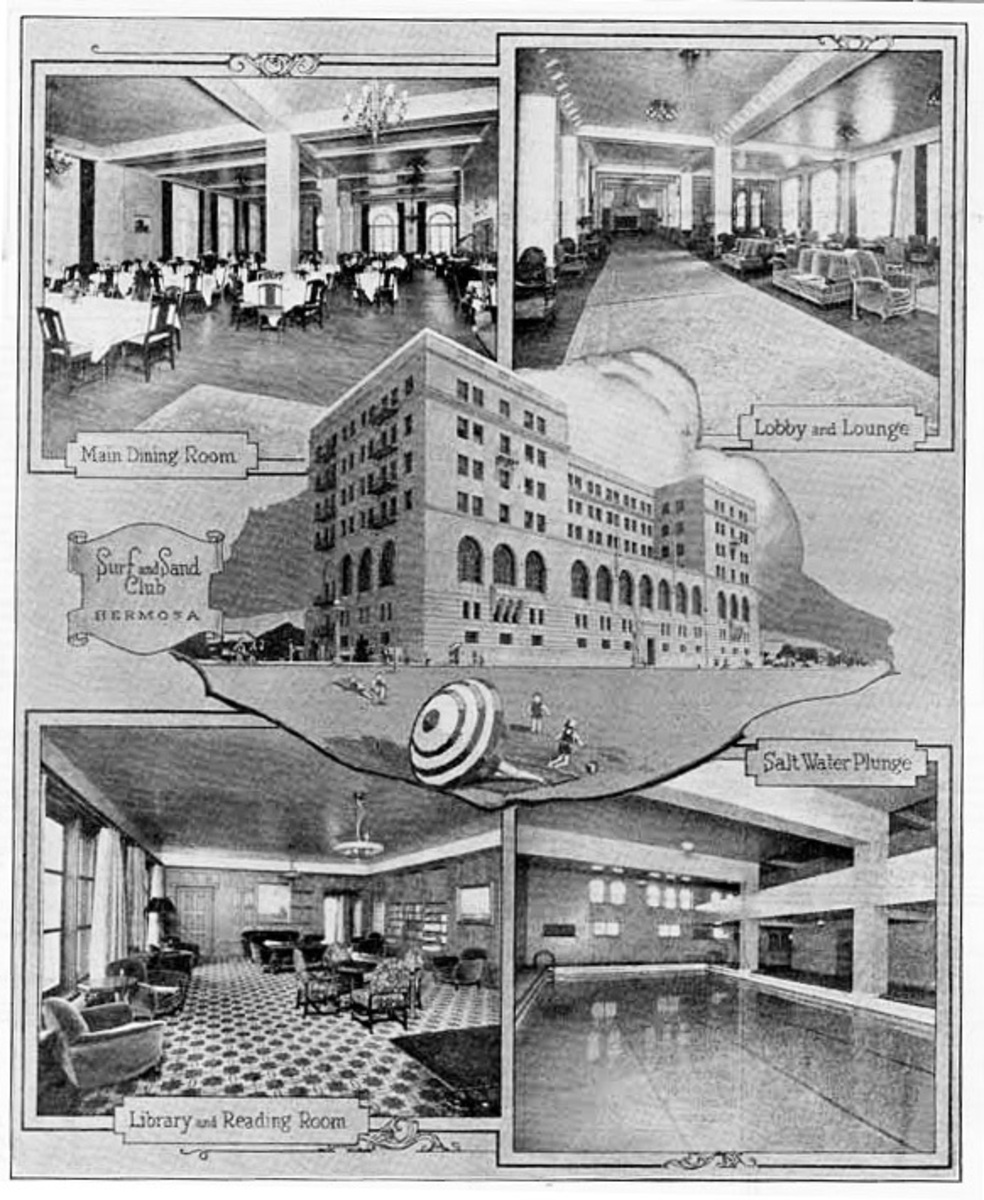
In the early 1920’s, The Surf and Sand Club was formed to help promote Hermosa Beach and its stretch of shoreline as a Southern California tourist destination. In March 1923, the club members announced plans to build a “clubhouse” on a plot of land at the Strand and 14th, where you now find the patch of dirt, succulents, and grass we call Noble Park. Back then however, the plans included an indoor swimming pool, a grill, bowling alley, billiard and card rooms, a large dining room, and sleeping quarters on the third and fourth floors.
What was to become Hermosa’s first high rise building quickly grew from four floors to six in early architect plans and would ultimately settle on eight floors. As word of the project got out, the first block of 250 memberships to The Surf and Sand Club sold out almost immediately and that number would top 1000 with the project’s completion a couple years later.
Construction began in December 1923 and five short months later in May 1924 there was already a dedication ceremony held at the clubhouse. The building was far from complete, only the first two floors had been constructed but the club wanted to show members the progress that had been made.
When club finally opened its doors to members in June 1925 it quickly became the focal point of the city’s growing beach culture scene, and one of the South Bay coast’s most visible landmarks. After its splashy start however, economics forced the Surf and Sand Club to merge with the Los Angeles Athletic Club in 1929 and a few years later the Biltmore Hotel Chain took ownership of the club. Though it would become a public hotel, it continued to operate under the Surf and Sand name for several years.
As late as 1935, the Surf and Sand Club still was trying to fence off the beach in front of its seaside clubhouse and make it private, but the city (rightful owner of the beach in front of the hotel) refused to accept the proposal.
Another proposal, this one from the federal government, was implemented on Jan. 5, 1939. The New Deal agency known as the National Youth Administration (NYA), took possession of the hotel, by this time known as the Hermosa Biltmore Hotel, with plans to use it as a dormitory and work unit. Youths would be housed there and then transported to Los Angeles-area sites for vocational training. In the midst of protest from Hermosa residents, this plan stayed in place only a few months - the government finally backed away, citing the hotel’s location as limiting and removing the student residents on Aug. 15, 1939.
The hotel struggled in the years following World War II, with a succession of different owners taking charge between 1949 and 1966. It became run-down in the process, its owners unable to provide for its upkeep. Ownership of the property reverted to the city of Hermosa Beach in 1966 and the building continued to deteriorate rapidly, turning into a crash pad for hippies and the like. A fire that destroyed much of the 2nd floor was blamed on these crashers.
Demolition of the now-decrepit building finally took place in 1969 and the city was left with an empty plot of land.
It shouldn’t have been too difficult deciding how best to use that land, but various uses for the Biltmore site (as listed in the editors notes below) were debated endlessly in meetings, planning sessions and public forums of various kinds for the next 20 years. Several were voted on as city ballot measures, and none of them came to fruition.
The early 1990’s brought another series of unresolved proposals - from a ballot proposition to sell the property for commercial development that passed by a mere 40 votes (spoiler alert, that didn’t ultimately go through), to seemingly the final vote in 1992 when 63% of voters approved a plan to transform the plot into a landscaped city park.
In 1994, the City Council nixed the outcome of the popular proposal and again asked the City’s voters what they wanted to do with the vacant land, and again the choice was to build a park, much to the dismay of pro-business, pro-tax revenue residents and leaders.
Weeks after final debate closed and plans were set to create a landscaped park, Hermosa residents Joe and Betty Noble donated $90,000 to cover the remaining construction costs for the park, and in return, the green space was named Noble Park. It was dedicated on Sept. 22, 1995.

Click to see all 5 Photos
Story 6 years ago
Sand & Surf Club
Leadership Hermosa Beach Class of 2019
en
Overview
Reviews 0
Reviews
0.0
0 comments
Provided by
Leadership Hermosa Beach Class of 2019
Leadership Hermosa Beach Class of 2019 project
This story belongs to
4.6