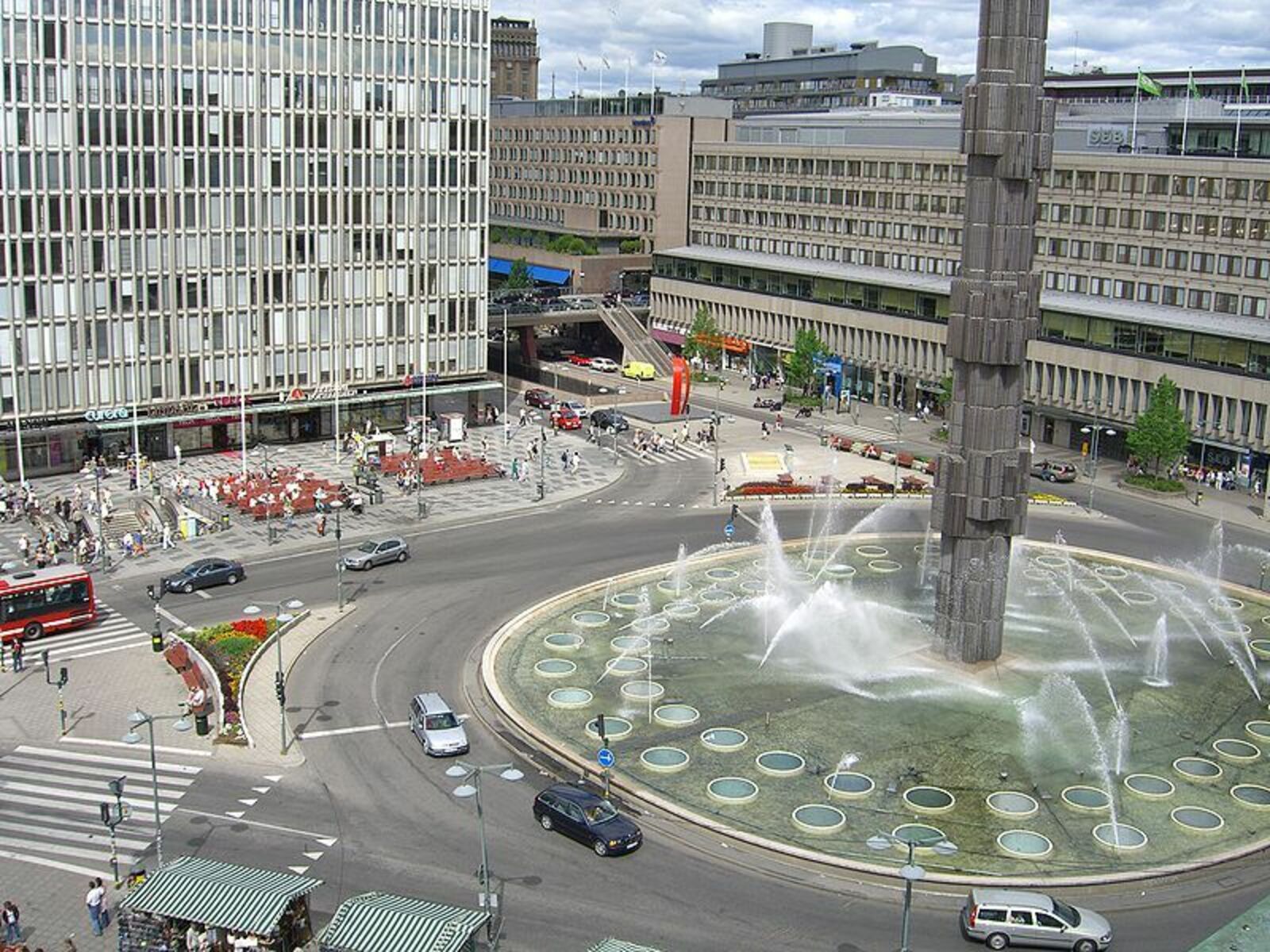

Remember all the old houses and narrow streets I told you about earlier? That’s what it looked like here in the 1950’s but as you remember, it was all torn down. Instead they built this square. Planning alone took over 30 years and construction - additional 7 years. This may well be at the same time the most hated and best loved place in. People here call it “the slab” but the real name is Sergels torg which means Sergel’s square. Sergel was one of the most famous sculptors in Sweden.
Sergels torg and the Slab - there’s a lot of contrast between the two names. And there’s a lot of contrast to be found in the place as well. Here you will find political manifestations. People on strikes, hoping for attention and recognition. Happy sports fans, filling the square to celebrate their favourite sports heroes. Most often the national hockey team, the Three Crowns. And is that all? No, I’m afraid not. In one of the main Swedish newspapers you could read this, not long ago: “People sell drugs and shoot heroin in plain sight on Sergels torg in Stockholm. Police and politicians keep promising to take measures but absolutely nothing happens”. It was signed by representatives of various anti-drug organizations. And they compared the trade around this square with the coffee shops in Holland. There’s a big difference, though: it’s not legal here.
But ask any Stockholmer over the age of 35 what Sergel’s torg brings to their mind and the answer would be something completely different. They would say: Maria. Maria was an old lady with a one-woman-orchestra. Every day, in any weather, here she was. Playing her organ, singing Christian songs and handing out homemade sandwiches to poor people. Until she passed away at the age of 84. Maria, rest in peace!
Photo Sergels torg 2006-07-15 by de:Benutzer:Stern is licensed under CC BY-SA 2.5