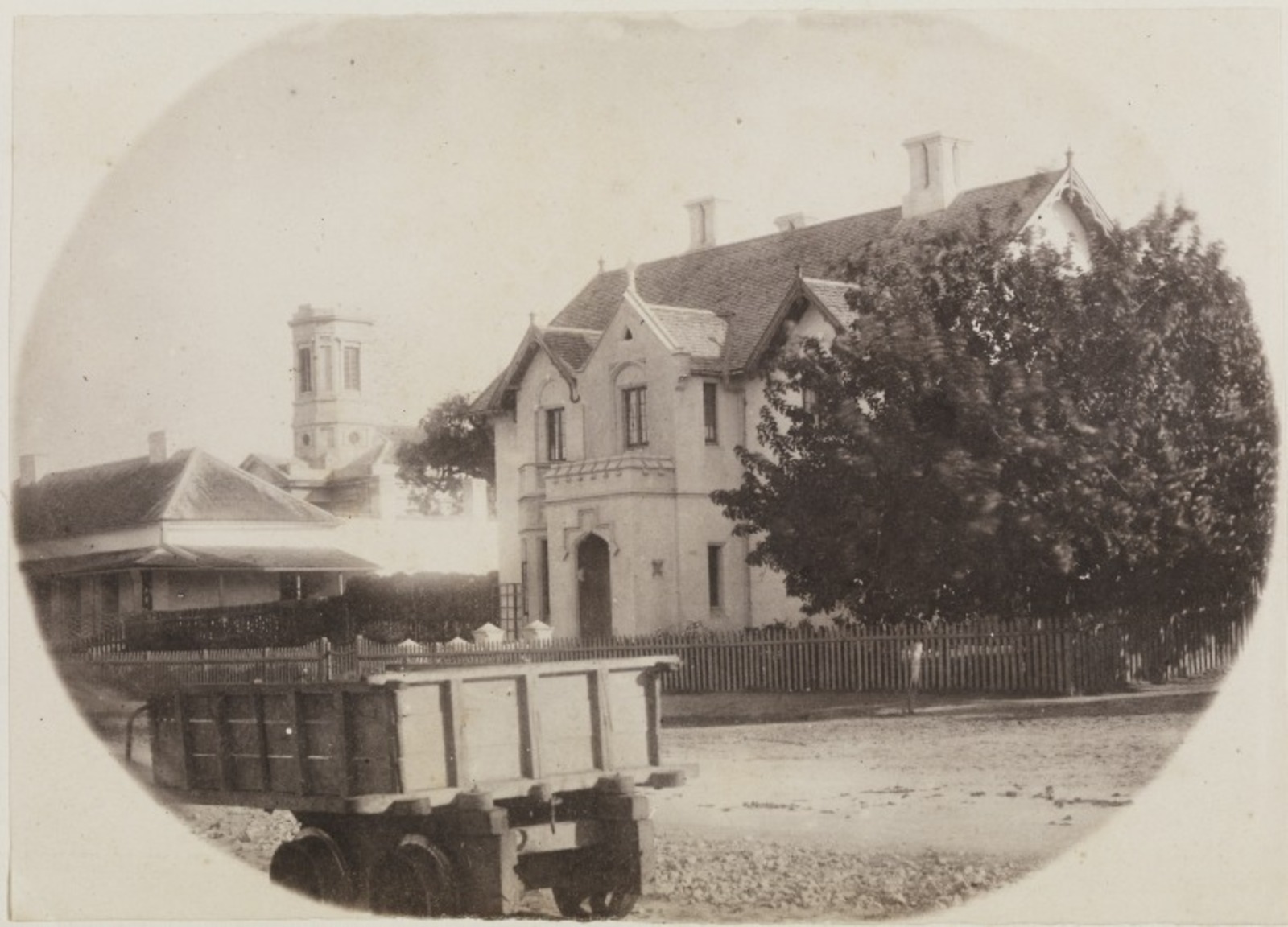

Once the site of a jail, the Deanery has been described as holding ‘a strong place in the affections of the people of Perth’, perhaps because its architectural style ‘expresses the nostalgia for England which was felt by so many of the early settlers’ (R&J Oldham) – and perhaps also by modern residents. As a brick building in the Victorian Tudor style, the Deanery is somewhat dwarfed by the magnificence of the buildings around it. Yet it appears true that the building is valued by the local community. In the 1950s, when the Anglican Church proposed to demolish the Deanery and replace it with a modern structure, the public outcry was so fierce that the Dean at the time paid for extensive repairs out of his own pocket. It is currently used as the Cathedral Offices.
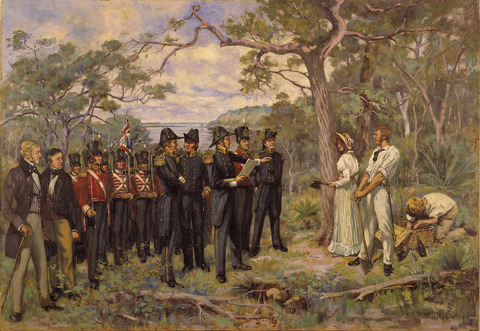
As we stand outside of this peaceful building, let us consider again what may be missing from the heritage that has been retained and presented to us. At the beginning of our tour you were introduced to Yellagonga, leader of the Mooro group, and his brother Midgegooroo, leader of the Beeliar group. I would like to share with you my very simple summary of a complex series of events. In 1833, Midgegooroo, his son Yagan, and an elder from the Beeloo group, Munday, were accused of murdering two white settlers. Midgegooroo was captured, and Yagan was declared an outlaw. On May 22nd of 1833, Midgegooroo was tied to the gate of the jail that once stood on the site of the Deanery. His death warrant was read aloud; there had been no fair or formal trial. He was immediately executed by firing squad and buried without ceremony in the grounds of the jail. Two months later, Yagan, unaware that he was an outlaw with a bounty on his head, was shot by an eighteen year old English colonist seeking the thirty pound reward. His head was brutally removed from his body, smoked for three months in an attempt to preserve it, then adorned in a costume of cockatoo feathers before being sent to the Liverpool Museum as a curio. The colonial government imposed further restrictions upon the Wadjuk Noongar people, forcing them outside of the town site to a camp at Mt Eliza. The Noongar people were prevented from accessing their hunting grounds and other sources of food, yet the government withheld rations from them and forced them further north to Lake Monger, and then to Lake Joondalup. Yellagonga died far from his home. Years later, Fanny Balbuk was unable to tend to her great-uncle Midgegooroo’s gravesite. Yagan’s head was buried in a plot in 1964, far from his home, along with the bodies of twenty-two stillborn babies from a local hospital. After a fierce and long fight by the Noongar community, the head was repatriated to Australia in 1997 and was buried with ceremony in 2010, but not without mockery and insensitive remarks from critics and members of the media.
Image Credits
1. The Deanery, corner of St Georges Terrace and Pier Street, Perth, c. 1861. Courtesy of the State Library of Western Australia [6923B/15]
2. 'Execution', Perth Gazette and Western Australian Journal 25 May 1833. Modified image found on http://historysnapshot.blogspot.com.au/
3. Photograph of Yagan statue by Nachoman-au (A digital photograph taken by myself.) [GFDL , CC-BY-SA-3.0 or CC BY-SA 2.5], via Wikimedia Commons
Text Credits
1. Daley, P, 2017, ‘The story of Yagan’s head is a shameful reminder of colonialism’s legacy’, The Guardian, accessed 17 May 2018, <www.theguardian.com>
2. Darbyshire, J 2013, 50 Years: Council House 1963 – 2013, City of Perth: Perth, Western Australia.
3. Perth Central Area Technical Advisory Committee 1978, Cathedral Precinct: Urban Design Study, Perth City Council: Perth, Western Australia.
4. Pickering, G (Ed.) 2017, Fanny Balbul Yooreel, Realising a Perth Resistance Fighter, National Trust of Australia: Perth, Western Australia.