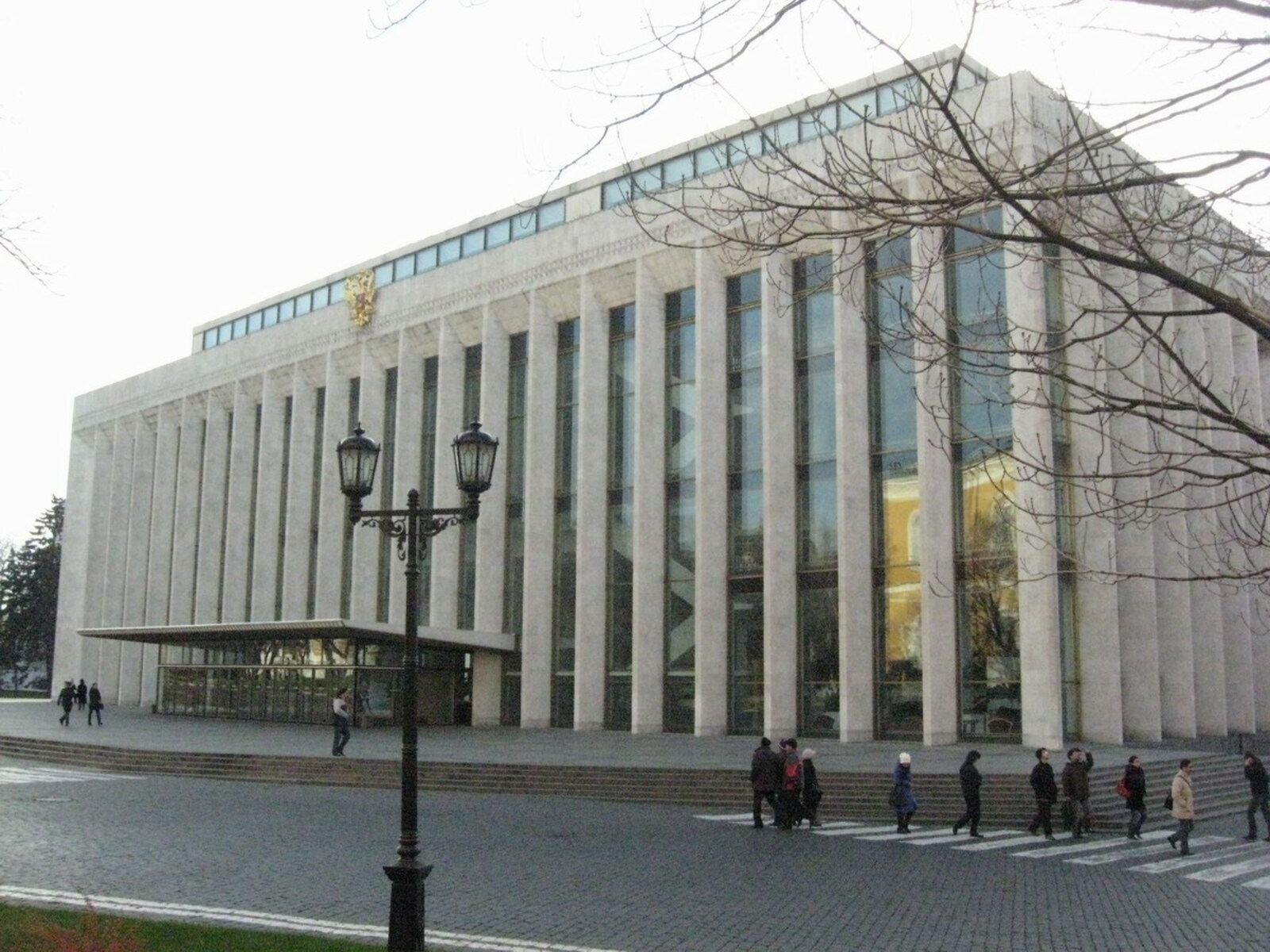


You've now entered the Moscow Kremlin! If you stand with your back to the Holy Trinity Tower, to your right-hand side is a stern modern building of white marble and glass, with a gilded two-headed eagle above – it's the State Kremlin Palace. Until 1992 its Soviet-era name was the Palace of Congresses.
The State Kremlin Palace was built in 1961 on the orders of Soviet premiere Nikita Khruschov. At the time it was named the Palace of Congresses, and it housed meetings of the Communist Party Congress and Government. From its inception it was conceived as a dual-purpose building, providing a second stage for the Bolshoi Theatre company for concerts and staged productions. Opera and ballet performances were regularly staged here, including premieres of the Bolshoi Theatre. Today the State Kremlin Palace is considered the most prestigious concert venue in Moscow.
The State Kremlin Palace is one of the rare Soviet-era buildings within the Kremlin. Its main facia, with the vertical marble columns, extends for some 120 meters. The exterior of the Palace is decorated with white Urals marble, golden anodized aluminium and glass. The whole thing went up in record time – just 16 months. To pack in the required floorspace within the building would have taken the building's height above the surrounding historic buildings of the Kremlin – the problem was solved by sinking the lower storeys of the building underground by 16 meters.
Nowadays the Kremlin State Ballet is based at the State Kremlin Palace. In addition, there are special Christmas Tree shows for children every New Year held here. The auditorium of the State Kremlin Palace can seat more than 6000 people. The hall was entirely revamped in 2003, with new sound and lighting systems installed.
The space where the State Kremlin Palace now stands was once occupied by the buildings of the Empire-style Armoury Chambers at the end of the C19th. Before the Armoury, the private royal chambers of Tsar Boris Godunov had stood here. When the Armoury here was demolished, the examples of old Russian weaponry were moved to the Arsenal instead, and mounted alongside the piles of captured French cannon. While builders were digging the foundations for the modern State Kremlin Palace, they came across remains of Boris Godunov's private chambers, and the C17th chambers of Tsaritsa Natalia Kirillovna, where Tsar Peter the Great would have spent his Moscow childhood.
Across the cobbled street from the main entrance of the State Kremlin Palace we see a yellow classical two-storey building, with cannon barrels lying on the ground in piles before it. This is the Arsenal building. It takes up the Northern corner of the Kremlin, between the Nikolskaya, Troitskaya and Arsenal Corner-Towers. In the square to the right of the Arsenal there's a monument to the students of the Kremlin Military School, founded in 1917-1918, who fell in the Civil War of 1918-1922.
The building of the Arsenal began under Tsar Peter the Great, in 1702. “Arsenal” isn't a Russian word, and was employed to mean an “Armoury Store”. Peter had originally intended it would display foreign arms captured in battle by the Russian forces – and in fact his reign was marked by numerous Russian victories by both land and sea. Today the building is used as offices for the Kremlin Commendant's staff, and the victories themselves are commemorated by the cannon-barrels lying outside. You can walk up to the cannons, although no further. Most of them were cast in various ordnance factories around Europe and arrived in Russia with Napoleon's armies. Look closely and you will see a large engraved letter “N” - for Napoleon - on many of the barrels. The others are old Russian arms, and several were cast at the Moscow cannon-foundry.
After Russia's victory over Napoleon in 1812 it had been intended to create a War Museum, and to this end captured cannon-pieces from the war had been brought to the Kremlin by 1819 and arranged outside the Arsenal building. In addition to examples of old Russian firing-pieces we find here 875 barrels of Napoleonic cannon, captured from Bonaparte's retreating army in 1812. 365 of these are French – the others include pieces cast in Austria, Prussia, the Kingdom of Naples, Bavaria, Italy and Holland. Several bear intriguing inscriptions – for example one Prussian barrel has the challenge ‘The King's clinching argument’. Another cannon previously belonging to King Stephan Bathory of Poland claims ‘I am the Basilisk – one touch from me, and walls collapse’.
The State Kremlin Palace was built in 1961 on the orders of Soviet premiere Nikita Khruschov. At the time it was named the Palace of Congresses, and it housed meetings of the Communist Party Congress and Government. From its inception it was conceived as a dual-purpose building, providing a second stage for the Bolshoi Theatre company for concerts and staged productions. Opera and ballet performances were regularly staged here, including premieres of the Bolshoi Theatre. Today the State Kremlin Palace is considered the most prestigious concert venue in Moscow.
The State Kremlin Palace is one of the rare Soviet-era buildings within the Kremlin. Its main facia, with the vertical marble columns, extends for some 120 meters. The exterior of the Palace is decorated with white Urals marble, golden anodized aluminium and glass. The whole thing went up in record time – just 16 months. To pack in the required floorspace within the building would have taken the building's height above the surrounding historic buildings of the Kremlin – the problem was solved by sinking the lower storeys of the building underground by 16 meters.
Nowadays the Kremlin State Ballet is based at the State Kremlin Palace. In addition, there are special Christmas Tree shows for children every New Year held here. The auditorium of the State Kremlin Palace can seat more than 6000 people. The hall was entirely revamped in 2003, with new sound and lighting systems installed.
The space where the State Kremlin Palace now stands was once occupied by the buildings of the Empire-style Armoury Chambers at the end of the C19th. Before the Armoury, the private royal chambers of Tsar Boris Godunov had stood here. When the Armoury here was demolished, the examples of old Russian weaponry were moved to the Arsenal instead, and mounted alongside the piles of captured French cannon. While builders were digging the foundations for the modern State Kremlin Palace, they came across remains of Boris Godunov's private chambers, and the C17th chambers of Tsaritsa Natalia Kirillovna, where Tsar Peter the Great would have spent his Moscow childhood.
Across the cobbled street from the main entrance of the State Kremlin Palace we see a yellow classical two-storey building, with cannon barrels lying on the ground in piles before it. This is the Arsenal building. It takes up the Northern corner of the Kremlin, between the Nikolskaya, Troitskaya and Arsenal Corner-Towers. In the square to the right of the Arsenal there's a monument to the students of the Kremlin Military School, founded in 1917-1918, who fell in the Civil War of 1918-1922.
The building of the Arsenal began under Tsar Peter the Great, in 1702. “Arsenal” isn't a Russian word, and was employed to mean an “Armoury Store”. Peter had originally intended it would display foreign arms captured in battle by the Russian forces – and in fact his reign was marked by numerous Russian victories by both land and sea. Today the building is used as offices for the Kremlin Commendant's staff, and the victories themselves are commemorated by the cannon-barrels lying outside. You can walk up to the cannons, although no further. Most of them were cast in various ordnance factories around Europe and arrived in Russia with Napoleon's armies. Look closely and you will see a large engraved letter “N” - for Napoleon - on many of the barrels. The others are old Russian arms, and several were cast at the Moscow cannon-foundry.
After Russia's victory over Napoleon in 1812 it had been intended to create a War Museum, and to this end captured cannon-pieces from the war had been brought to the Kremlin by 1819 and arranged outside the Arsenal building. In addition to examples of old Russian firing-pieces we find here 875 barrels of Napoleonic cannon, captured from Bonaparte's retreating army in 1812. 365 of these are French – the others include pieces cast in Austria, Prussia, the Kingdom of Naples, Bavaria, Italy and Holland. Several bear intriguing inscriptions – for example one Prussian barrel has the challenge ‘The King's clinching argument’. Another cannon previously belonging to King Stephan Bathory of Poland claims ‘I am the Basilisk – one touch from me, and walls collapse’.